
Online Violin Lessons for Adults: It’s Genuinely Not Too Late
Online Violin Lessons for Adults: It’s Genuinely Not Too Late
Adults asking about violin almost always start with the same disclaimer. “I know it’s probably too late, but…” Then they describe what they actually want, to play a piece they’ve loved for years, to learn the instrument their grandmother played, to take on something difficult that they’ve quietly thought about for decades.
Here’s the honest answer. Violin is harder than most instruments in the first year. That part is real. But “too late” is wrong. Adults learn violin every day, reach genuinely satisfying playing levels, and often describe it as one of the most meaningful things they’ve taken on. Online violin lessons for adults are now widely available, and the format works well once you find the right teacher.
This is a clear-eyed look at what’s actually involved.
Why Violin Is Special for Adults
There’s a reason violin attracts adults disproportionately to many other instruments. The sound itself is part of it: the violin produces tone in a way that feels intimate and human, closer to the singing voice than almost any other instrument. The repertoire is part of it: the violin has one of the deepest catalogs of beautiful music in the Western tradition, from folk fiddle through Bach to film scores.
The emotional pull is part of it too. People who come to violin as adults often have a specific connection: a relative who played, a piece they fell in love with as a child, a fantasy of being able to play a melody by ear. That kind of intrinsic motivation is rare and valuable. Adults who start violin without it tend to drift. Adults who start with it tend to keep going.
The cognitive and wellbeing benefits documented for adult music learning apply fully to violin. Our piece on the benefits of learning music as an adult covers the research in detail: the short version is that taking on a complex motor and cognitive skill in adulthood has measurable benefits for memory, mood, and brain health.
What’s Genuinely Hard (Be Honest)
It’s worth being honest about what makes violin harder than piano or guitar in the early phase.
No frets. Every other major fretted or keyed instrument has visible markers for where notes are. Violin doesn’t. You’re learning to place your fingers in exactly the right spot by feel and ear, simultaneously, from day one. This takes time and produces a lot of out-of-tune sound in the first few months.
The bow. Producing a clean, sustained tone on the violin is its own separate skill from the left hand. Bow weight, speed, angle, contact point: all of these affect tone. Most adults can play recognizable melodies on piano in their first lesson. On violin, the first lesson is usually just about how to hold the instrument and the bow without injuring yourself.
Listening tolerance. Beginner violin sounds scratchy. Not because you’re failing, but because beginner violin always sounds scratchy. You have to tolerate that period (usually a few months) while your bow control improves. This is harder than it sounds, especially for adults who have a lifetime of refined musical taste.
Physical demands. The violin asks you to hold an awkward posture, support an instrument under your chin with your left side, and use the right side asymmetrically. Most adults need some focused work on body position and tension to play comfortably. Not impossible, but unlike piano, you can’t just sit down and play.
If you’re a complete beginner curious about what the path actually looks like, our guide to beginner violin tips covers the early-stage realities in more depth.
What’s Easier Than People Think
Here’s the part most articles about adult violin lessons skip. There are real things that are actually easier for adults than for children.
Adults can follow instructions. A teacher can say “place your second finger slightly higher than where you have it” and an adult understands and adjusts. Kids learn through more repetition and less explanation.
Adults can self-direct practice. A six-year-old needs structured assignments. An adult can take a general instruction, “work on the third position transitions this week”, and figure out how to use their practice time.
Adults can hear pitch problems and correct them. The musical ear adults bring to the instrument is usually more developed than they realize, even without formal training. You can hear when a note is off. That’s half the battle on a fretless instrument.
Adults have musical taste. You know what you want to play. You know what kind of tone you want to produce. This is enormously useful. It gives you specific goals to aim for instead of just generic “get better.”
Adults can manage frustration. A six-year-old quits when something’s hard. An adult can recognize the frustration, breathe, and keep going. That alone shortens the timeline to real skill.
Online violin lessons for adults benefit especially from these traits, because the format relies on the student bringing engagement, focus, and self-direction to the sessions.
What You Need to Start
The good news: starting violin doesn’t require a huge investment.
An instrument. A modest student violin in the $200-$500 range is more than enough for the first year or two. Rentals are also widely available and often a smart starting move. Don’t buy expensive until you’re sure you’re staying with it.
A bow, case, rosin, and shoulder rest. Usually included with student violins. The shoulder rest in particular makes a big difference in posture and comfort, a teacher in your first lesson can help you adjust it.
A tuner. A clip-on tuner that attaches to the scroll of the violin is invaluable for beginners. You can tune by ear eventually, but for the first months, a tuner removes a frustrating variable.
A space. Violin is louder than most beginners expect. A room where you won’t worry about neighbors, with enough space to fully extend the bow, is ideal.
A teacher. This matters more for violin than for almost any other instrument, because the technical decisions made in the first few months are genuinely hard to correct later. A good teacher from the start is the single best investment you can make. Our guide to the best online violin lessons for beginners goes deeper on what to look for.
How to Find the Right Adult-Friendly Teacher
Not all violin teachers are equally good with adults. A few things to specifically look for.
A teacher who has actually taught adults, and ideally talks about it on their profile. Many violin teachers built their practice around children, and their teaching style hasn’t fully adapted to adult learners. Adult-friendly violin teachers usually mention it explicitly.
A teacher who’s willing to start with adult-relevant repertoire. If the first six months are folk songs, simple pieces from films, or melodies the student actually wanted to learn, motivation stays high. If it’s children’s method-book pieces with no musical interest, adult students drop out fast.
A teacher who takes the time to address physical comfort and tension. Adults bring more pre-existing posture habits and body tension than kids do. A good adult-violin teacher works on this from the start.
A teacher who’s patient with the early scratchy phase and doesn’t make the student feel bad about it. Some teachers, especially those used to talented kids, are unconsciously impatient with normal beginner sound. The right teacher for an adult is the one who finds it interesting, not annoying.
Older students may also find useful framing in our piece on music lessons for seniors, which applies to anyone starting later in life regardless of specific age.
The first year of online violin lessons for adults is the steepest part. After that, the curve flattens, the tone improves, and the music starts to sound like music. People who get through the first year almost always stay with it. The question isn’t whether it’s too late. It’s whether you’re willing to spend a year on the steep part to earn the decades of playing that come after.
How to Find a Violin Teacher on Tunelark
Tunelark has violin teachers who specifically work with adult beginners and adult returners. Here’s how to find the right one.
1. Browse our teachers and filter by violin.
2. Read bios. Look for teachers who mention working with adults and who describe their approach to beginners.
3. Book a trial lesson with one whose profile resonates.
4. In the trial, watch for whether the teacher addresses your posture and bow hold patiently, and whether the energy in the lesson feels respectful of you as an adult learner.
It’s not too late. Online violin lessons for adults are real, accessible, and produce real players. The hardest year of your violin life is the first one, and the right teacher makes even that one a lot more enjoyable than you’d expect.
Frequently Asked Questions
Am I too old to start violin?
No. Adults across a wide range of ages start violin and reach genuinely satisfying levels. The first year is harder than other instruments, but no age range is too late. People begin in their fifties, sixties, and seventies and play for years afterward.
How long until I can play a real piece?
For most adult violin beginners, simple recognizable melodies are within reach in two to three months. A piece you’d actually want to play for someone (clean tone, in tune, with phrasing) usually arrives somewhere in the second half of the first year. The timeline is real, not optimistic.
Will online violin lessons work as well as in-person?
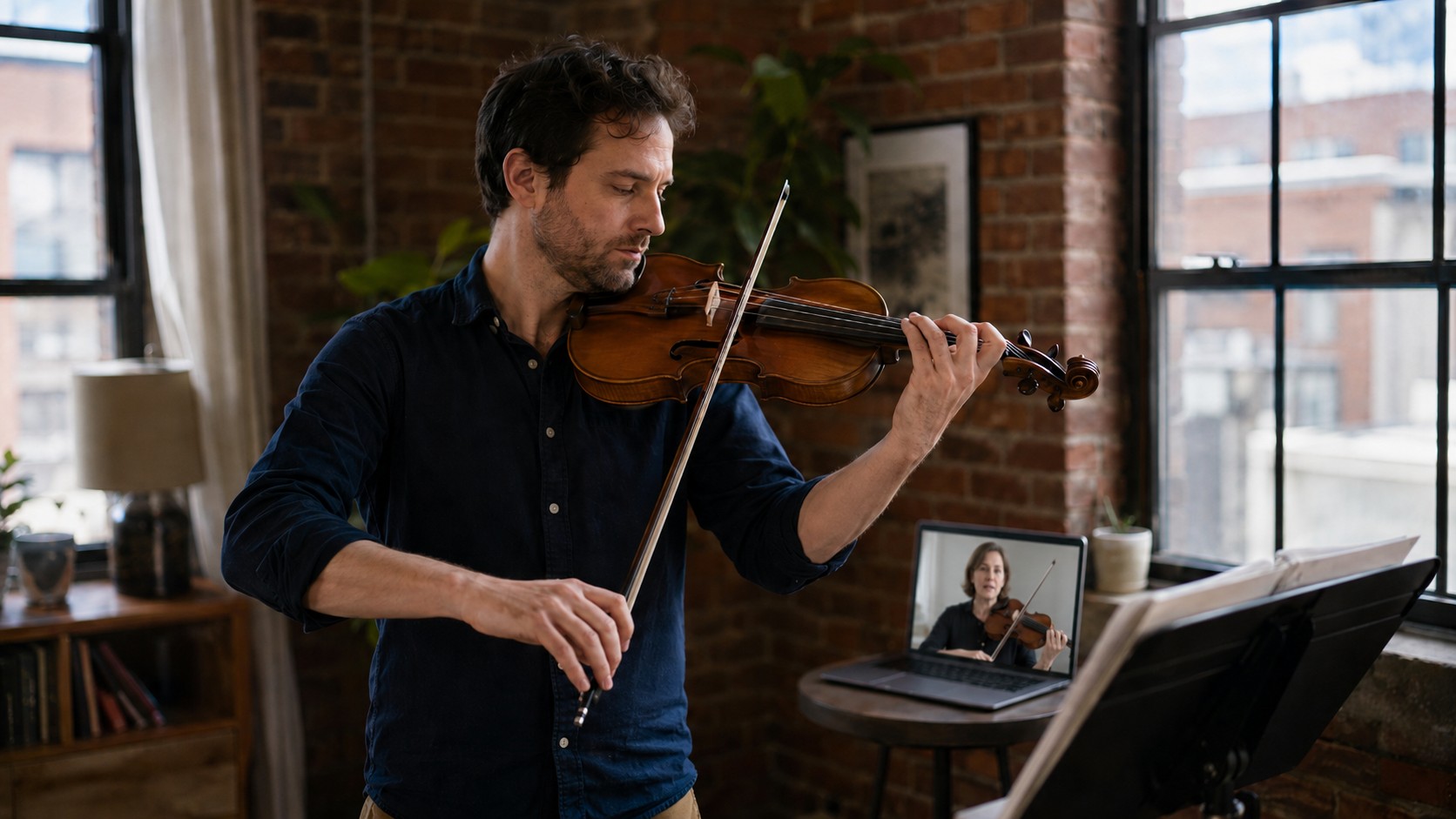
For most adult students, yes. The teacher can see your bow hold, posture, and left hand clearly on a basic webcam. The main limitations are around very advanced bowing nuances and ensemble work, neither of which matters much in the first few years.
Do I need a high-quality violin to start?
No. A modest student instrument in the $200-$500 range is fully sufficient for the first year or two, and rentals are widely available. Upgrading later, when you know what you want, is the smarter path.
Will my hands hurt at first?
Some mild fingertip soreness in the first few weeks is normal as the calluses develop. Significant or persistent pain is not normal and usually indicates a posture or tension issue your teacher should address. Tell your teacher early about any discomfort, fixing it in the first month is much easier than fixing it later.
Looking for an online violin teacher? See our full Online Violin Lessons page for everything you need to know about getting started.
Keep reading
About Jennifer Heath
I'm Jennifer Heath, VP at Tunelark and a lifelong singer. I joined the company in 2020 and oversee much of what makes Tunelark work for our students and our teachers. That includes hiring, training, and supporting our instructors, customer and student support, marketing, and the day-to-day operations of the business.
I started voice lessons at age 7, sang with professional choirs that toured internationally through my teens, and performed solo at competitions and community events across Texas before stepping away in my twenties to study other interests, including business management. I haven't performed professionally in years, but I'll happily take the microphone at a karaoke night. Music has been in me every day of my life. Being able to spend the last six years working inside an online music education company, while traveling the world full-time, has been a perfect fit.
I believe deeply that music belongs in every life. For the self-expression, the discipline, the comfort, and the simple joy of it.
The Tunelark blog is where we share what we've learned about online music lessons: how to choose an instrument and a teacher, what to expect from your first lesson, how the major platforms compare, and how to keep music going through the busier seasons of life. Practical, honest writing you can act on.
Who we are
Tunelark provides virtual 1-on-1 music lessons to learners
of all ages.
We remove the barrier of geography and connect learners and teachers — wherever they are. Our growing community of vetted, experienced music educators have expertise in a wide variety of instruments, genres, and skill levels. We are passionate about connecting each student with the perfect instructor.

