
Best Online Violin Lessons: A Beginner’s Guide to Finding the Right Teacher
Best Online Violin Lessons: A Beginner’s Guide to Finding the Right Teacher
Violin is one of the most rewarding instruments to learn, and one of the most punishing if you start with the wrong teacher. The early posture habits (where your chin sits, how your bow arm moves, how relaxed your left hand is) get cemented in the first three to six months. If those habits are wrong, you’ll spend years undoing them. If they’re right, your progress accelerates from the very beginning.
The best online violin lessons, for a beginner, are about exactly this: building good fundamentals so that everything you learn later sits on top of a solid base. This guide walks through how to find a teacher who can do that, what online violin lessons can and can’t do, and what to set up on your end.
Can Violin Really Be Taught Online?
The short answer is yes, and there’s now a decade of working violin teachers and successful online students to prove it. The longer answer is that it depends on what kind of online teacher you’re working with.
Violin is, in some ways, harder to teach online than it would be in person, particularly for absolute beginners, where small hand and posture adjustments make a big difference. A great violin teacher knows how to compensate: where to position the camera, what to ask the student to do so they can see what they need to see, what to demonstrate from their own instrument, and how to give clear verbal cues for things they can’t physically adjust.
A teacher who has thought through this format will tell you, in the first lesson, where to set up your camera and what they need to see. A teacher who hasn’t will sometimes fumble through the first few lessons trying to figure it out. The first sort is who you want.
What to Look For in a Beginner Violin Teacher
Three things matter most:
Suzuki method or traditional method experience, or both. Both teaching traditions have produced thousands of excellent violinists. What matters is that your teacher has a clear methodology, not just “we’ll figure it out as we go.”
Comfort teaching beginners specifically. Some violin teachers love advanced students and find beginners frustrating. Others love starting from zero and watching a student build from nothing. You want the second kind. Read the bio. Ask about it directly.
Patience with posture and bow technique. The first six months of violin study are mostly about posture, bow grip, bow direction, and a relaxed left hand. A good teacher will spend significant lesson time on these things, even when the student wants to play “real songs.” Don’t push back. The technique work IS the path to the real songs.
What to Set Up at Home
A few small things make online violin lessons dramatically more effective:
The right size violin. This is non-negotiable. Children need a violin sized to their arm length, 1/16, 1/10, 1/8, 1/4, 1/2, 3/4, or 4/4. Your teacher should be able to tell you which size, and a local music store or online rental service can help. Playing on the wrong size violin is one of the fastest ways to develop bad habits.
A music stand. Sheet music on a coffee table or propped against the wall is a posture problem waiting to happen.
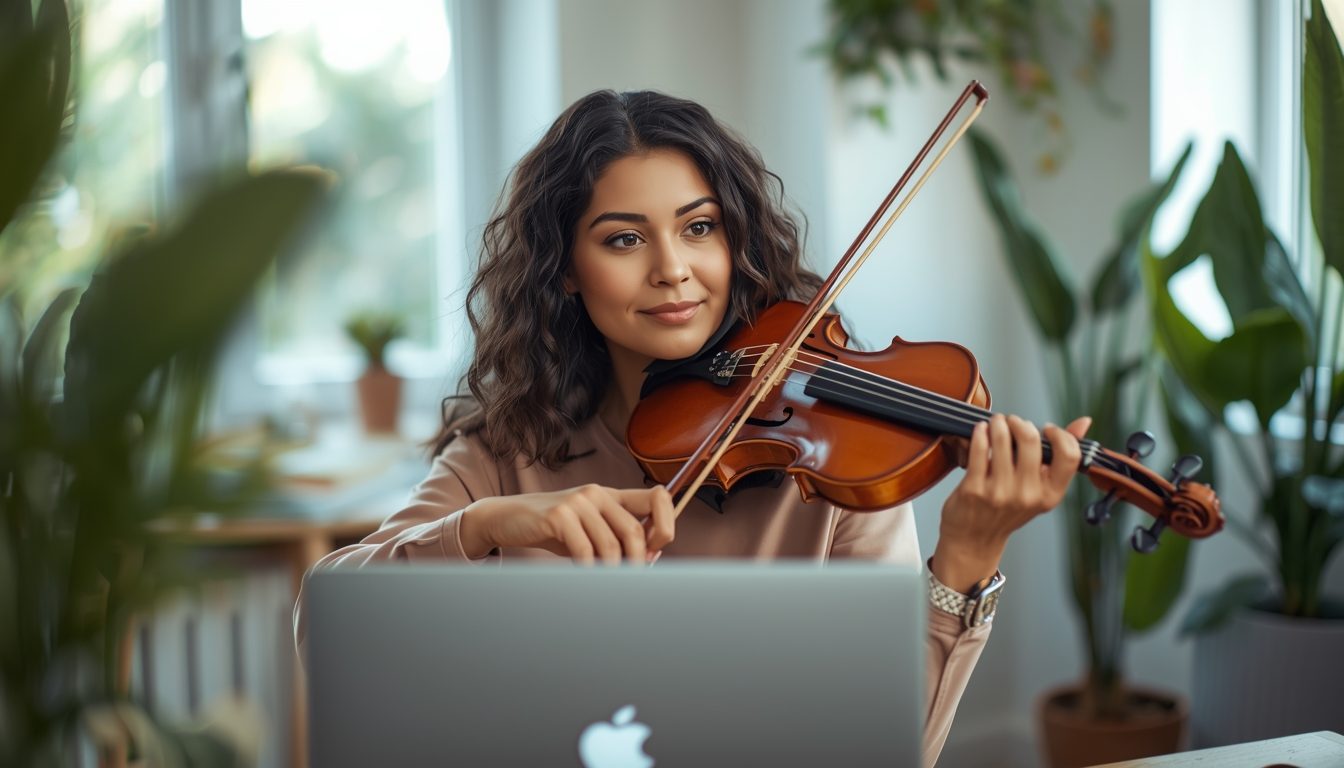
Camera position. Your teacher needs to see your face (for jaw and chin position), your bow arm (for bow direction and parallel-to-bridge work), and your left hand (for finger position). The simplest workable setup is a laptop on a music stand or tall surface, with the camera angled to capture you from waist up.
A way to tune the violin. Beginners can’t tune their own violins reliably. A small clip-on tuner or a tuner app makes the start of every practice session smooth.
How Long Does It Take to See Real Progress?
Be patient. Violin is one of the slower instruments to feel comfortable on. Most beginners don’t sound “good” (by their own ear) until somewhere between six and twelve months of consistent practice.
That’s not a sign you’re doing it wrong. It’s a sign you’re learning an inherently difficult instrument. The students who stick with it are usually the ones whose teacher has set good expectations and helped them celebrate small wins along the way.
For more on the long view of music learning, our How to Stay Motivated During Music Lessons guide walks through the plateaus and breakthroughs you can expect.
How to Find a Violin Teacher on Tunelark
Every violin teacher on Tunelark has been hand-vetted for teaching experience, credentials, and ability to teach effectively online. To find a teacher:
1. Browse our teacher list and filter for violin.
2. Read the bios. Look for teachers who explicitly mention working with beginners.
3. Book a trial lesson with one or two whose profile resonates. Trial lessons are discounted by design. They’re meant to be a low-cost way to test fit.
4. If the first teacher isn’t quite right, switching is straightforward.
The right teacher pays for themselves many times over in the speed of your progress and in the foundations they help you build. Take the time to find the right one. The years of beautiful violin playing ahead of you will thank you.
Frequently Asked Questions
Can adults learn violin online?
Absolutely. Many adults learn violin successfully online. The teacher can see your bow grip, posture, and left-hand position clearly via camera and provide real-time feedback.
What size violin do I need for online lessons?
Adults typically use a full-size (4/4) violin. Children need smaller sizes based on arm length. Your teacher can help measure. Most beginners rent first to avoid buying the wrong size.
How long until I can play a recognizable song on violin?
Most students play simple recognizable melodies within 2–3 months of weekly lessons and daily practice. Playing with confidence and good tone takes longer, typically a year or more.
Do I need to read music to learn violin?
Not at first. Many beginners start by ear or with simplified notation. Reading music becomes more useful at the intermediate level. Your teacher can introduce notation when you’re ready.
What’s a reasonable budget for a beginner violin?
A rental violin runs $20–$40 per month and is ideal for beginners. If buying, a starter violin in the $200–$500 range from a reputable dealer is appropriate. Avoid very cheap violins. They’re often unplayable.
Looking for an online violin teacher? See our full Online Violin Lessons page for everything you need to know about getting started.
Keep reading
About Jennifer Heath
I'm Jennifer Heath, VP at Tunelark and a lifelong singer. I joined the company in 2020 and oversee much of what makes Tunelark work for our students and our teachers. That includes hiring, training, and supporting our instructors, customer and student support, marketing, and the day-to-day operations of the business.
I started voice lessons at age 7, sang with professional choirs that toured internationally through my teens, and performed solo at competitions and community events across Texas before stepping away in my twenties to study other interests, including business management. I haven't performed professionally in years, but I'll happily take the microphone at a karaoke night. Music has been in me every day of my life. Being able to spend the last six years working inside an online music education company, while traveling the world full-time, has been a perfect fit.
I believe deeply that music belongs in every life. For the self-expression, the discipline, the comfort, and the simple joy of it.
The Tunelark blog is where we share what we've learned about online music lessons: how to choose an instrument and a teacher, what to expect from your first lesson, how the major platforms compare, and how to keep music going through the busier seasons of life. Practical, honest writing you can act on.
Who we are
Tunelark provides virtual 1-on-1 music lessons to learners
of all ages.
We remove the barrier of geography and connect learners and teachers — wherever they are. Our growing community of vetted, experienced music educators have expertise in a wide variety of instruments, genres, and skill levels. We are passionate about connecting each student with the perfect instructor.

