
Is It the Wrong Instrument, or Just Normal Frustration? A Teacher’s Test
Sooner or later, almost every music student hits the same doubt. A stretch of lessons stops feeling like progress, practice turns into a slog, and a quiet question creeps in: maybe I picked the wrong instrument. Maybe I would love this if I had chosen something else. It is one of the most common reasons people drift away from music, and it is also one of the most misread, because ordinary mid-learning frustration and a genuine bad fit can feel identical from the inside.
Neel S. is well placed to sort them out. He is a multi-instrumentalist who teaches guitar and voice at Tunelark and plays piano too, and his own path ran straight through this exact question. His answer gives you a test you can actually use.
The doubt is normal, and exploring is allowed
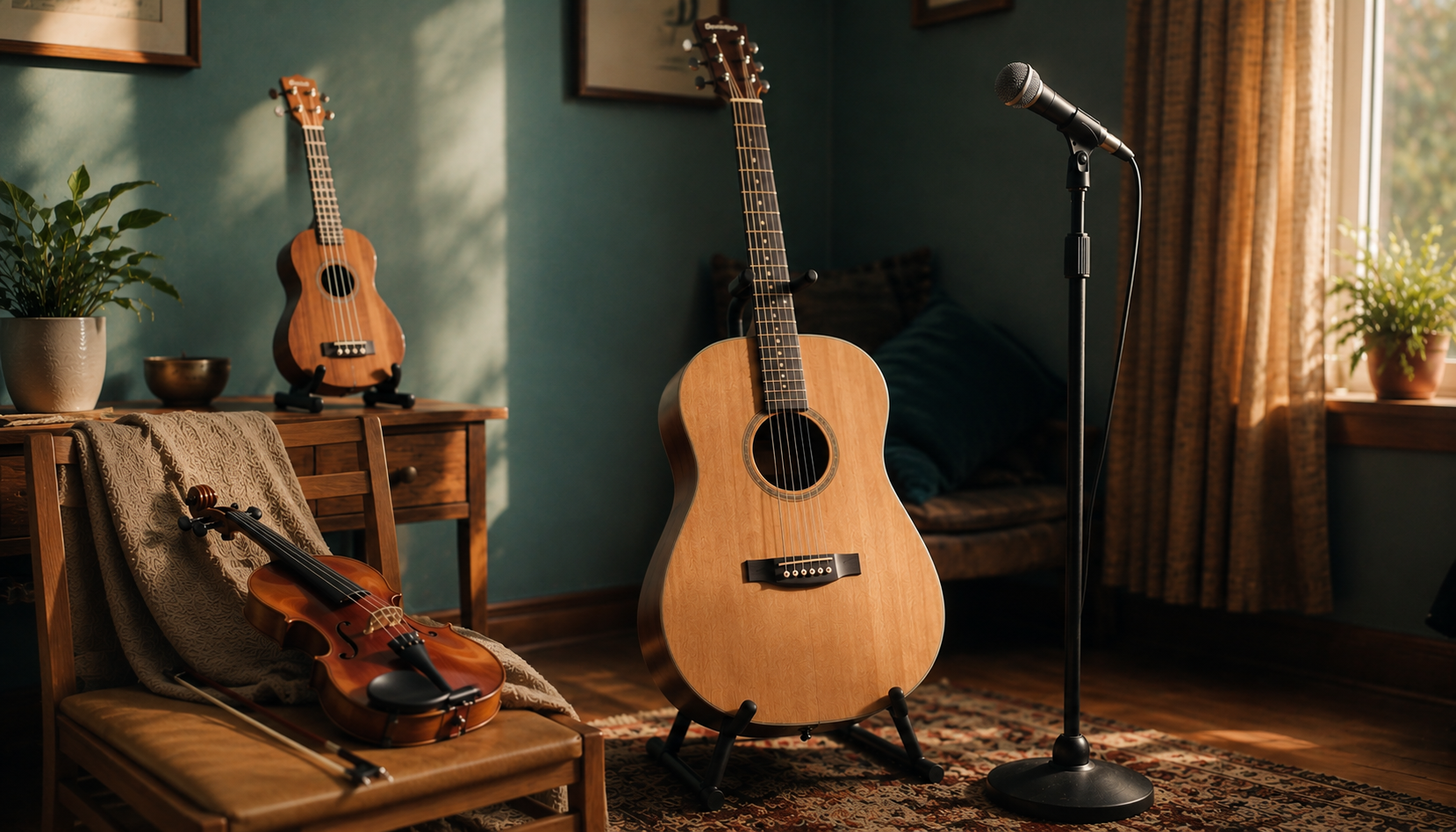
Neel wants students to know the question itself is healthy, not a sign of failure. “I’ve had many students who look at my studio and see all the instruments in my room and wonder, should I be learning some other instrument? Is there a better one for me, or a better one to start on? Could we try it?” he says. His response is never to shut it down. “I always encourage my students to explore these options, and I invite them to take a lesson or even half a lesson to let me teach them the basics.” Curiosity about other instruments is not disloyalty to the one in your hands. It is information.
He knows this because his own story turned on it. “I started learning classical piano as a child. I loved music so much, but I was really struggling to fall in love with the piano,” he says. His teacher was strict and taught as traditionally as possible, “but it did not work on me.” He gave up piano. Then something shifted. “It wasn’t long before the guitar started to call to me. I loved the way it looked, I loved its portability, and most importantly, I loved its sound. Once I picked it up, it was a totally different world. I was learning so quickly, playing and singing songs within weeks.” The detail that keeps this from being a simple “piano bad, guitar good” story is the ending. “Importantly, I did return to the piano many years later and really enjoy it.” The instrument was not the enemy. The fit, at that age, in that way, was.
The test: does the instrument show you it is worth it?
Neel draws a clean line between an instrument that is wrong for you and the ordinary friction every instrument demands.
“Every instrument comes with some friction,” he says. “Our hands have to adapt, our vocal cords need to be trained, and our muscle control needs to be strengthened.” That struggle is universal and unavoidable, which is exactly why it is such a poor signal on its own. The test is not whether it is hard. Everything worthwhile is hard. The test is what happens around the hard part.
“The difference between picking the right instrument and powering through frustration is that the right instrument will show you that it’s worth it, every step of the way,” Neel says. “You’ll hear others play it, and you’ll be moved to practice yourself. You’ll spend hours working on the same thing, but when you get it, it’s magic.” A good fit pays you back. You hear someone play and you want to go practice. You grind at one passage for an hour and the moment it lands feels like magic, not relief. A bad fit gives you the grind without the payoff, over and over, until nothing about it pulls you back.
And crucially, he says, you cannot know which one you are dealing with from the outside. “You won’t know the difference between something that isn’t a good fit versus the usual frustration without giving yourself a chance to see for yourself.” That is why his instinct is always to let a curious student try, rather than to lecture them about commitment. The trying is how you find out.
Sometimes the pull is the sound itself
What signals a good fit is rarely a spreadsheet of pros and cons. It is a pull, often toward a particular sound.
Gillian H. can name the exact moment an instrument chose her. “Hearing solo upright bass with a bow,” she says. “Those low frequencies literally stopped me in my tracks.” That is the opposite of being handed an instrument and told to make it work. It is the instrument reaching out and grabbing you, which is one of the surest signs of a good fit. If a specific sound has ever stopped you like that, pay attention to it, especially if you are coming to music as an adult and get to choose freely this time.
Alex P. approaches fit from the music a student actually wants to play. “As a teacher, I always try to connect anything I teach to songs my students like,” he says. “That keeps them motivated.” And he refuses to force it. “If a student dislikes a song I suggest, I will find another that’s more to their liking.” That is fit at the song level rather than the instrument level, but it works the same way. When the instrument is earning its keep by getting you closer to music you love, the friction feels worth it. When it never seems to lead anywhere you care about, that tells you something. Alex writes more about this in his piece on choosing your first real piece.
You are allowed to try more than one
Neel also wants students to let go of the idea that they have to marry the first instrument they pick. “Find your magic wand, and then make magic,” he says. “It’s ok to try a couple of wands, or even pick more than one. Just make magic.”
He has watched a second instrument breathe life back into a first. One student started on voice, added guitar to accompany himself, and then, while learning theory on the piano for its visual clarity, decided he wanted to try piano too. “After a couple of lessons on piano, he really found himself enjoying it, and it seemed to revitalize his interest in guitar and voice, too, but from a piano-first perspective.” Exploring did not scatter his focus. It renewed it. Sometimes the cure for feeling stuck on one instrument is a few lessons on another, which sends you back to the first with fresh ears.
For parents: the same test applies to your kid
If you are a parent watching a child lose steam, this reframes the usual worry. When a kid wants to quit, the instinct is to read it as a character problem, a lack of discipline to be corrected. Neel’s test suggests a gentler first question: is this ordinary friction, or is the instrument genuinely not pulling them in? The two look the same from the outside, and they call for very different responses. It is worth distinguishing a child who wants to quit from one who simply dislikes practicing before deciding anything, and if it really is a fit issue, choosing the right instrument for a child is a solvable next step rather than a dead end.
The same is true for adults deciding where to begin. There is no wasted time in trying, and choosing a first instrument as an adult beginner is easier when you treat it as an experiment you are allowed to adjust, not a lifelong vow. And before you conclude an instrument is wrong for you, it is worth checking whether the real issue is how you have been practicing, because the two can feel the same and only one requires a change of instrument.
The bottom line
The right instrument is not the one with the least friction. It is the one that keeps showing you it is worth the friction, that pulls you back to practice, that turns a hard-won passage into something that feels like magic. Every instrument will frustrate you. Only the wrong one frustrates you without ever paying you back. And the only way to tell the difference is to give yourself, or your child, the chance to find out, ideally with a teacher who welcomes the question instead of treating it as a threat.
Find a teacher who will help you find your fit
Every teacher above teaches at Tunelark, and the multi-instrument spirit runs through how they teach. Whether you are choosing a first instrument, wondering if you are on the right one, or curious about adding a second, the right teacher treats that as part of the journey. Browse our teachers and book a trial lesson with someone who will help you find the instrument that keeps showing you it is worth it.
Frequently Asked Questions
How do I know if I picked the wrong instrument or just need to push through?
A useful test, from a multi-instrumentalist teacher, is whether the instrument shows you it is worth the effort. A good fit pulls you back to practice and makes hard-won progress feel like magic, even through frustration. A genuine misfit gives you the struggle without the payoff, again and again, with nothing drawing you back.
Is it normal to want to switch instruments partway through learning?
Completely normal, and teachers treat the question as healthy curiosity rather than a lack of commitment. Every instrument comes with friction, so wanting to explore is common. A good teacher will often let you try another instrument for a lesson or two so you can feel the difference for yourself.
Can learning a second instrument help with the first?
Often, yes. One teacher describes a student who added guitar and then piano and found that each new instrument renewed his interest in the others. Exploring a second instrument can send you back to your first with fresh ears and fresh motivation, rather than scattering your focus.
My child wants to quit their instrument. Is it the wrong one?
It might be, or it might be ordinary frustration or a dislike of practicing, which can look identical from the outside. Before deciding, it helps to distinguish a genuine fit problem from a temporary dip in motivation. If it truly is a fit issue, switching to a better-matched instrument is a reasonable step rather than giving up on music.
How should an adult beginner choose a first instrument?
Treat it as an experiment you are allowed to adjust, not a permanent decision. Pay attention to which instruments and sounds genuinely pull you in, since that attraction is a strong signal of fit. A teacher can help you try options and build early lessons around music you love, so the instrument earns its place quickly.
Keep reading
About Jennifer Heath
I'm Jennifer Heath, VP at Tunelark and a lifelong singer. I joined the company in 2020 and oversee much of what makes Tunelark work for our students and our teachers. That includes hiring, training, and supporting our instructors, customer and student support, marketing, and the day-to-day operations of the business.
I started voice lessons at age 7, sang with professional choirs that toured internationally through my teens, and performed solo at competitions and community events across Texas before stepping away in my twenties to study other interests, including business management. I haven't performed professionally in years, but I'll happily take the microphone at a karaoke night. Music has been in me every day of my life. Being able to spend the last six years working inside an online music education company, while traveling the world full-time, has been a perfect fit.
I believe deeply that music belongs in every life. For the self-expression, the discipline, the comfort, and the simple joy of it.
The Tunelark blog is where we share what we've learned about online music lessons: how to choose an instrument and a teacher, what to expect from your first lesson, how the major platforms compare, and how to keep music going through the busier seasons of life. Practical, honest writing you can act on.
Who we are
Tunelark provides virtual 1-on-1 music lessons to learners
of all ages.
We remove the barrier of geography and connect learners and teachers — wherever they are. Our growing community of vetted, experienced music educators have expertise in a wide variety of instruments, genres, and skill levels. We are passionate about connecting each student with the perfect instructor.

