
What Music Teachers Actually Want You to Do When You Practice
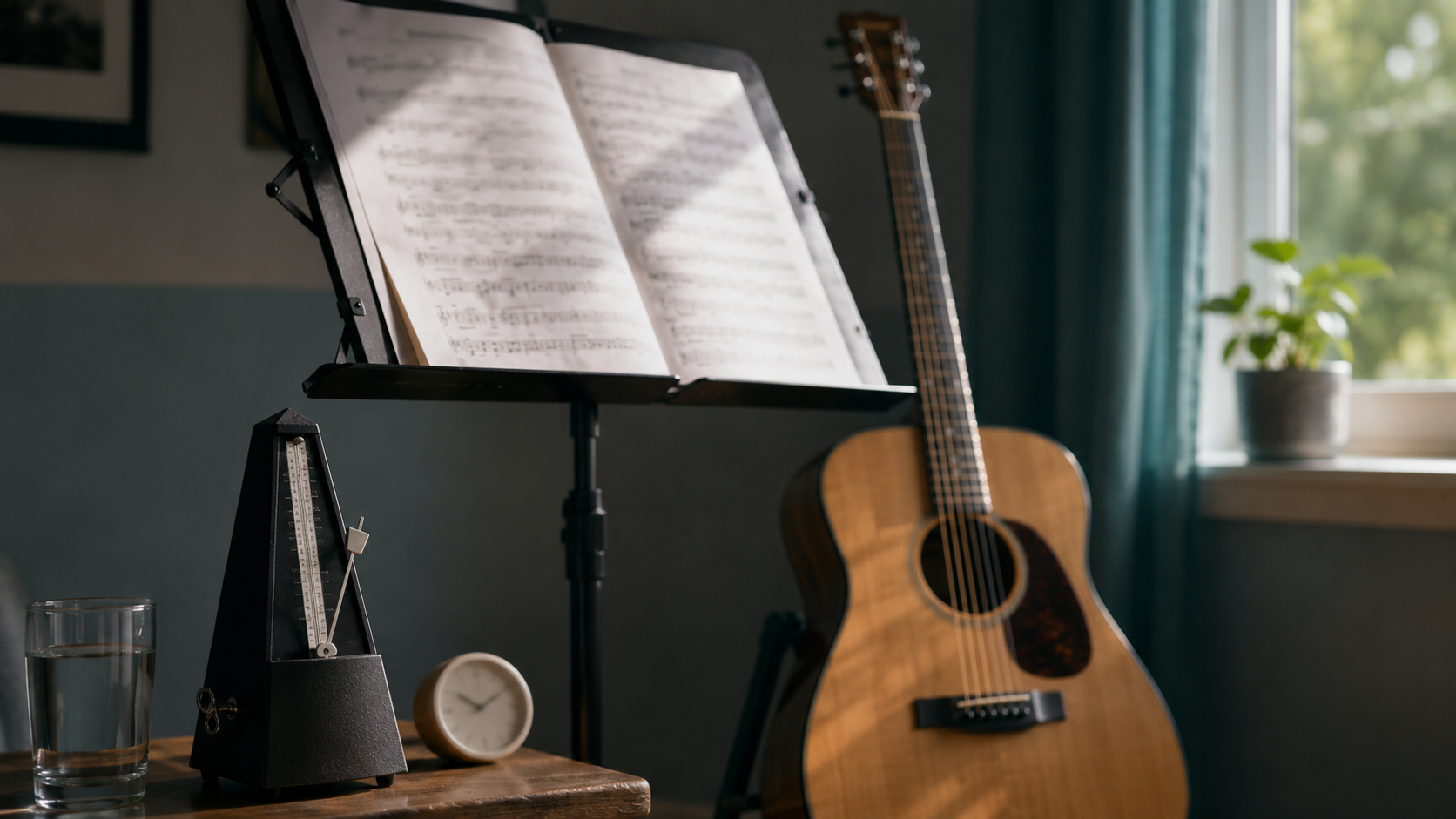
Most people feel guilty about practicing, and most of that guilt traces back to a single belief: that more time is the answer, and anything less than a long daily session does not really count. It is a quietly destructive idea, because it makes a busy person feel like a failure and then, often, makes them quit. The teachers at Tunelark want you to know it is also wrong.
We asked several of them what they actually recommend to real students, not the theoretical ideal but the routine that works. Their advice lands on three corrections, and each one is more forgiving, and more effective, than the rule most beginners are trying to live up to.
Correction one: quality beats quantity, and it is not close
The first thing to let go of is the hour. Tony G. has watched enough students to be blunt about it. “A focused 10-minute practice session done consistently will almost always produce better results than an unfocused hour of just noodling around,” he says. Ten minutes with attention beats sixty minutes without it, reliably.
He is not just making a point about efficiency. He is warning against a trap he has seen swallow students whole. “Sometimes students become so attached to a practice-time goal that they end up discouraging themselves,” he says. “They miss a day, fall short of their target, and start feeling like they’re failing. Eventually, some of them stop practicing altogether because they can’t live up to the standard they’ve set for themselves.” The hour-a-day rule does not just fail to help. It actively pushes people out. His preference is the opposite. “I’d rather see someone practice 10 focused minutes consistently than spend an hour practicing once a week and feeling guilty the rest of the time.” He makes the full case in his piece on what ten minutes of daily practice actually buys you, and the research on short daily practice backs him up.
Correction two: practice with purpose, and take care of the instrument
If the session is short, it has to be intentional, which is the second correction. “I always encourage students to practice with purpose,” Tony says. “Don’t just go through the motions. Be intentional about what you’re trying to improve, even if it’s something very small.” A focused ten minutes on one chord change or one tricky bar will move you further than an hour of aimless playing, but only if you know what you are working on when you sit down. This is also where a teacher earns their keep, since part of their job is ending each lesson with you knowing exactly what to practice and why.
The other half of this correction is one almost every beginner skips, and Alawna M. makes it central for singers: take care of the instrument, which for a singer means the body. “Most students skip the cool-down process after practicing, rehearsal, or a performance,” she says. “Cooling down the voice, resetting and resting the voice are the most important pieces to maintain a healthy, functioning voice.” She has a memorable way of explaining why. “Think of it like a two-hour car ride and the tank being close to empty. It’s best to find a gas station, turn off the car for a little, and refill the gas for it to drive again.”
She also offers a specific tweak that saves singers from hurting themselves in pursuit of a hard note. Rather than belting the same difficult phrase over and over, which “can cause strain, tension, frustration,” she sets limits. Warm up and run functional exercises first, then attempt the hard song only a few times, up to three, before moving on. Her full routine lives in her article on a voice practice routine that actually works, and it applies past singing: protecting the instrument, whether that is your hands or your voice, is part of practicing well, not separate from it.
Correction three: practice should feel like music, not duty
The third correction is the one that ties the others together, and Harry B. states it most memorably. “When practice is fueled by love and genuine curiosity, we can accomplish leagues of progress in 30 minutes,” he says, “and when it’s fueled by duty, we barely move ahead at all.” The same half hour produces wildly different results depending on what is driving it. Curiosity compounds. Obligation drags.
His advice for the moments when practice curdles into a grind is refreshingly gentle, and it doubles as a cure for feeling stuck. “Practice should always feel like music,” he says, “and if it feels like you’re struggling, step away from your instrument and come back to play a simple song you know well and just think of how lucky you are to be playing music in this moment.” That is not a productivity hack. It is permission to protect the reason you started, which turns out to be the thing that keeps you practicing at all. He connects this directly to getting unstuck in his piece on what to do when your playing stops improving.
Mary Beth S. frames the same idea as the whole point of her teaching. “The goal is for everyone to fall in love with their voice, so that they actually practice and become more skilled,” she says. “The more they love it, the more they will reach their personal goals and milestones.” The order matters. Love comes first, practice follows from it, and skill follows from the practice. Try to force the practice without the love and the whole chain tends to break.
A practice routine you can actually keep
Put the three corrections together and you get something far kinder than the rule most people are failing to follow. Keep it short. Ten focused minutes beats a distracted hour, and it beats an hour you skip out of guilt. Keep it purposeful. Know the one small thing you are improving before you start, and take a moment to care for your hands or your voice on the way out. And keep it musical. If it starts feeling like a chore, play something you love and remember why you are here.
That is a routine a busy adult can actually sustain, which matters more than any ideal, because the practice you keep beats the practice you quit. If you want to build it into your week, it helps to see how to practice at home, how much practice actually makes a difference, and a realistic practice routine designed for adults.
One last note, from the same teachers. If practice consistently feels like pure duty no matter how you structure it, that is worth paying attention to. Sometimes the problem is not your discipline at all. Sometimes it is a sign the instrument itself is not the right fit, which is a separate and very solvable question we cover in how to tell if you are playing the right instrument.
Find a teacher who builds practice around your life
Every teacher above teaches at Tunelark, and every one of them would rather you practice a little, consistently, and enjoy it, than burn out chasing an hour a day. A good teacher leaves you, at the end of each lesson, knowing exactly what to work on and how to fit it into the time you really have. Browse our teachers and book a trial lesson with someone who will build a practice plan around your life instead of an unrealistic ideal.
Frequently Asked Questions
How long should I practice music each day?
Less than you probably think. Our teachers say a focused ten minutes done consistently beats an unfocused hour, and beats a long session you skip out of guilt. Consistency and attention matter far more than total time, so a short daily habit you can actually keep is the better goal for most people.
Is it better to practice a little every day or a lot once a week?
A little every day, according to our teachers. Short, regular sessions build skill more reliably than one long weekly session, and they avoid the guilt cycle that makes people quit. If you only have ten focused minutes, use them, and let the consistency do the work.
What does “practicing with purpose” actually mean?
It means knowing the specific thing you are trying to improve before you sit down, even if it is very small, rather than just playing through material on autopilot. A focused ten minutes on one chord change or one difficult bar moves you further than an hour of aimless playing. A good teacher helps by ending each lesson with a clear focus for the week.
Why does my practice feel like a chore, and what can I do about it?
Our teachers say practice fueled by duty produces far less progress than practice fueled by curiosity. When a session starts to feel like a grind, one teacher suggests stepping away and playing a simple song you already love to reconnect with why you started. If practice feels like pure obligation no matter what, it can also be a sign the instrument itself may not be the right fit.
How do I protect my voice or hands while practicing?
Take care of the instrument as part of the routine. For singers, that means warming up, limiting how many times you push a difficult note, and cooling the voice down afterward to let it rest and recover. The same principle applies to any instrument: build in care for your body so that practice strengthens rather than strains you.
Keep reading
About Jennifer Heath
I'm Jennifer Heath, VP at Tunelark and a lifelong singer. I joined the company in 2020 and oversee much of what makes Tunelark work for our students and our teachers. That includes hiring, training, and supporting our instructors, customer and student support, marketing, and the day-to-day operations of the business.
I started voice lessons at age 7, sang with professional choirs that toured internationally through my teens, and performed solo at competitions and community events across Texas before stepping away in my twenties to study other interests, including business management. I haven't performed professionally in years, but I'll happily take the microphone at a karaoke night. Music has been in me every day of my life. Being able to spend the last six years working inside an online music education company, while traveling the world full-time, has been a perfect fit.
I believe deeply that music belongs in every life. For the self-expression, the discipline, the comfort, and the simple joy of it.
The Tunelark blog is where we share what we've learned about online music lessons: how to choose an instrument and a teacher, what to expect from your first lesson, how the major platforms compare, and how to keep music going through the busier seasons of life. Practical, honest writing you can act on.
Who we are
Tunelark provides virtual 1-on-1 music lessons to learners
of all ages.
We remove the barrier of geography and connect learners and teachers — wherever they are. Our growing community of vetted, experienced music educators have expertise in a wide variety of instruments, genres, and skill levels. We are passionate about connecting each student with the perfect instructor.

