
Do Music Learning Games Actually Work? What the Research Says

Every music student eventually meets the flashcard deck, the theory workbook, or the drill sheet, and many of them quietly hate it. So when a company like ours says “play games instead,” you have every right to be skeptical. Is a game with hearts, badges, and a progress bar really teaching anything, or is it just a nicer way to waste practice time?
It is a fair question, and it has been studied far more rigorously than most people realize. The short answer: well-designed learning games measurably improve learning, the effect is real but not magic, and the reasons they work have less to do with fun than you would guess.
What the meta-analyses actually found
A meta-analysis pools the results of many independent experiments, which makes it the most reliable evidence available. Several large ones have now looked at gamified and game-based learning.
A 2020 meta-analysis in Educational Psychology Review by Michael Sailer and Lisa Homner pooled dozens of controlled studies and found that gamification produced significant improvements in cognitive learning outcomes, with a moderate effect size (g = 0.49), along with smaller but reliable gains in motivation and behavior. A 2016 review of digital learning games in Review of Educational Research reached a similar conclusion across 69 studies: students learning with digital games outperformed students in conventional instruction. The same review found something more useful than the headline number. Games worked substantially better when students played across multiple sessions rather than one long sitting, and better designs beat flashier graphics every time.
Music education has its own evidence. A 2024 meta-analysis of 31 studies on technology in music teaching found a positive, moderate effect on achievement. In a 2026 study of beginning piano students, children who learned foundational theory through game-based challenges with real-time feedback dramatically outperformed a traditional-instruction group on pitch and rhythm knowledge after eight weeks. And a six-month study of adult amateurs using a note and chord recognition app found the app group scored roughly 20 points higher on theory and ear-training assessments than the control group.
Why games work: it is not the fun
The largest meta-analysis of “serious games,” published in the Journal of Educational Psychology, found something counterintuitive: games improved learning and retention compared to conventional instruction, but were not significantly more motivating in the moment. Students did not necessarily report loving the games more. They just learned more from them.
That points to the real engine underneath a good learning game, and it turns out to be three of the best-established findings in all of learning science.
Retrieval practice. Answering a question from memory strengthens that memory far more than re-reading or re-studying it. In the classic experiments by Roediger and Karpicke, students who were quizzed on material remembered substantially more a week later than students who studied it repeatedly, even though the studiers felt more confident. Every round of a note-naming game is retrieval practice in disguise. The game asks, you answer from memory, and the memory gets stronger.
Spacing. A synthesis of 317 experiments found that practice distributed across days reliably beats the same amount of practice crammed into one session. Games are built for this. Ten minutes today, ten minutes Thursday, ten minutes over the weekend. The structure of levels and streaks nudges you into exactly the schedule your memory wants, which is the same reason short daily practice sessions work so well on your instrument.
Immediate feedback. John Hattie and Helen Timperley’s landmark review put feedback among the most powerful influences on achievement ever measured, roughly twice the effect of typical schooling, provided the feedback is about the task rather than the person. A game corrects you within a second of the mistake, every single time. No workbook can do that, and even the best teacher cannot sit beside a student for every minute of practice between lessons.
What good game design looks like
The research also draws a clear line between gamification done well and gamification done lazily. Slapping points and badges onto a chore does not transform it, and a meta-analysis of 128 reward experiments found that tangible prizes dangled for performance can actually undermine a learner’s own interest in the activity. Critical reviews of classroom gamification make the same point: the mechanics have to serve the learning, not decorate it.
What does serve the learning, according to the design research, is challenge matched to skill. Psychologists call the resulting state flow, the full absorption that arrives when a task is neither boringly easy nor hopelessly hard. Self-determination theory, the dominant scientific account of motivation, adds that people stay motivated when they feel competent and in control of their own progress.
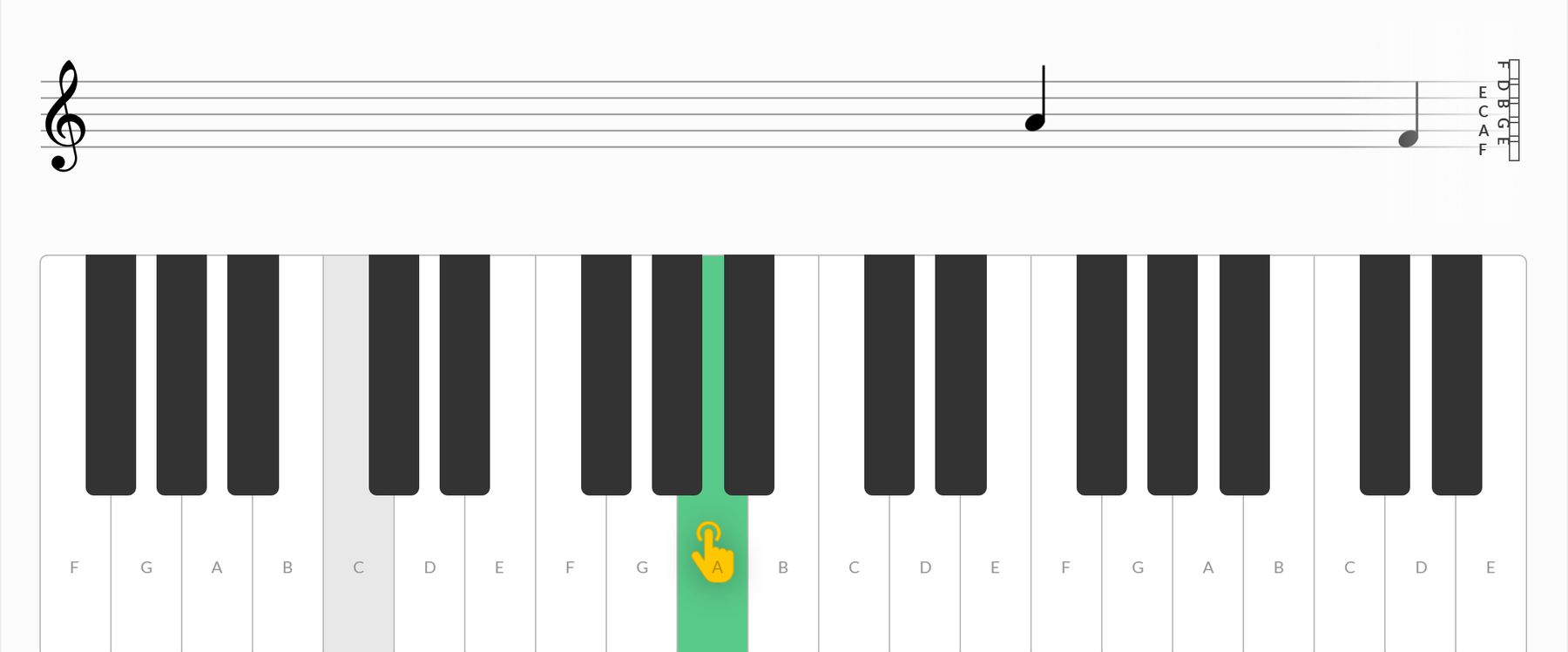
This is the standard we built Tunelark’s music learning games around. There are more than 150 games covering note reading in treble, bass, and alto clef, music theory, and ear training, and each one is level based. You start where you are, the difficulty climbs as you master each level, and the feedback lands the moment you answer. You can play with an on-screen keyboard, a MIDI keyboard, or your acoustic instrument through the microphone. Progress, experience points, and mastered skills accumulate across sessions, so the short-and-spaced schedule the research recommends is simply how the games want to be played. You can try a note reading game right now without an account.
The honest caveats
Research-based means telling you the limits too. Effects vary widely with design and context, and when one review restricted itself to only the most rigorous studies, the advantage of games over well-designed conventional instruction shrank considerably. The evidence for games as a supplement is much stronger than the evidence for games as a replacement.
That last point matters most. The serious-games meta-analysis found games worked best when combined with other instruction, not instead of it. A game can drill note reading until it is automatic. It cannot hear that your wrist is tense, notice that you light up when a song finally clicks, or decide what you are ready for next. That is a teacher’s job. The game’s job is to make sure the fundamentals are solid when you arrive at the lesson, and the research says it does that job well. Understanding why music theory matters in the first place makes the pairing even stronger, and for children the games sit inside a much bigger picture of what music education does for development.
Where the games fit at Tunelark
The games began as Tunelark’s flagship product, built for school music classrooms, and they are still free for verified classroom teachers today. Every Tunelark private lesson student and teacher also gets full access at no cost. Students play between lessons, teachers assign specific skills and see exactly where each student is strong or stuck, and lesson time goes to music instead of drilling. For adults finally tackling music theory and for kids who resist flashcards, the games are the same product doing the same job: making the fundamentals automatic.
How to Find a Music Teacher on Tunelark
Full access to the entire game library comes free with Tunelark lessons, so the way to get the games is the way to get everything else: find a teacher you love. It takes a few minutes:
1. Browse teachers at tunelark.com/find-a-teacher and filter by instrument.
2. Read a few bios and watch the intro videos to get a feel for each teacher’s style.
3. Book a trial lesson with the one who feels right. Your first lesson is $25 off.
4. After the lesson, ask yourself how you feel. Encouraged and curious is the standard to hold out for, and the games will be waiting in your account either way.
Frequently Asked Questions
Do learning games really improve music skills, or just game skills?
The improvement transfers. Controlled studies measured outcomes on standard written and aural assessments, not in-game scores, and game-trained students still came out ahead. The mechanisms doing the work, retrieval practice, spaced repetition, and immediate feedback, are the same ones that strengthen any learning.
Are music learning games better than a teacher?
No, and the research does not claim they are. Games outperform passive study methods like re-reading and unguided drilling, but they work best as a supplement alongside instruction. A game drills fundamentals until they are automatic. A teacher hears technique, builds repertoire, and keeps the whole journey on course.
How often should a student play music learning games?
Short and frequent beats long and rare. The spacing research favors sessions of roughly ten to twenty minutes spread across several days over a single long sitting. Tunelark’s games save progress across sessions, so stopping after a level or two and returning tomorrow is exactly how they are meant to be used.
Do points and badges spoil a child’s real interest in music?
Rewards can backfire when they are dangled as payment for an activity a child already enjoys. Well-designed games avoid that trap by using points and levels as feedback on growing skill rather than as prizes. The goal is a feeling of competence, which is one of the strongest known drivers of lasting motivation.
Who gets access to Tunelark’s music learning games?
Every Tunelark private lesson student and teacher has full access included with lessons, and verified school classroom teachers can get free accounts for their classes. Anyone can try a demo game without an account.
Keep reading
About Jennifer Heath
I'm Jennifer Heath, VP at Tunelark and a lifelong singer. I joined the company in 2020 and oversee much of what makes Tunelark work for our students and our teachers. That includes hiring, training, and supporting our instructors, customer and student support, marketing, and the day-to-day operations of the business.
I started voice lessons at age 7, sang with professional choirs that toured internationally through my teens, and performed solo at competitions and community events across Texas before stepping away in my twenties to study other interests, including business management. I haven't performed professionally in years, but I'll happily take the microphone at a karaoke night. Music has been in me every day of my life. Being able to spend the last six years working inside an online music education company, while traveling the world full-time, has been a perfect fit.
I believe deeply that music belongs in every life. For the self-expression, the discipline, the comfort, and the simple joy of it.
The Tunelark blog is where we share what we've learned about online music lessons: how to choose an instrument and a teacher, what to expect from your first lesson, how the major platforms compare, and how to keep music going through the busier seasons of life. Practical, honest writing you can act on.
Who we are
Tunelark provides virtual 1-on-1 music lessons to learners
of all ages.
We remove the barrier of geography and connect learners and teachers — wherever they are. Our growing community of vetted, experienced music educators have expertise in a wide variety of instruments, genres, and skill levels. We are passionate about connecting each student with the perfect instructor.

