
The Best Video Setup for Online Music Lessons
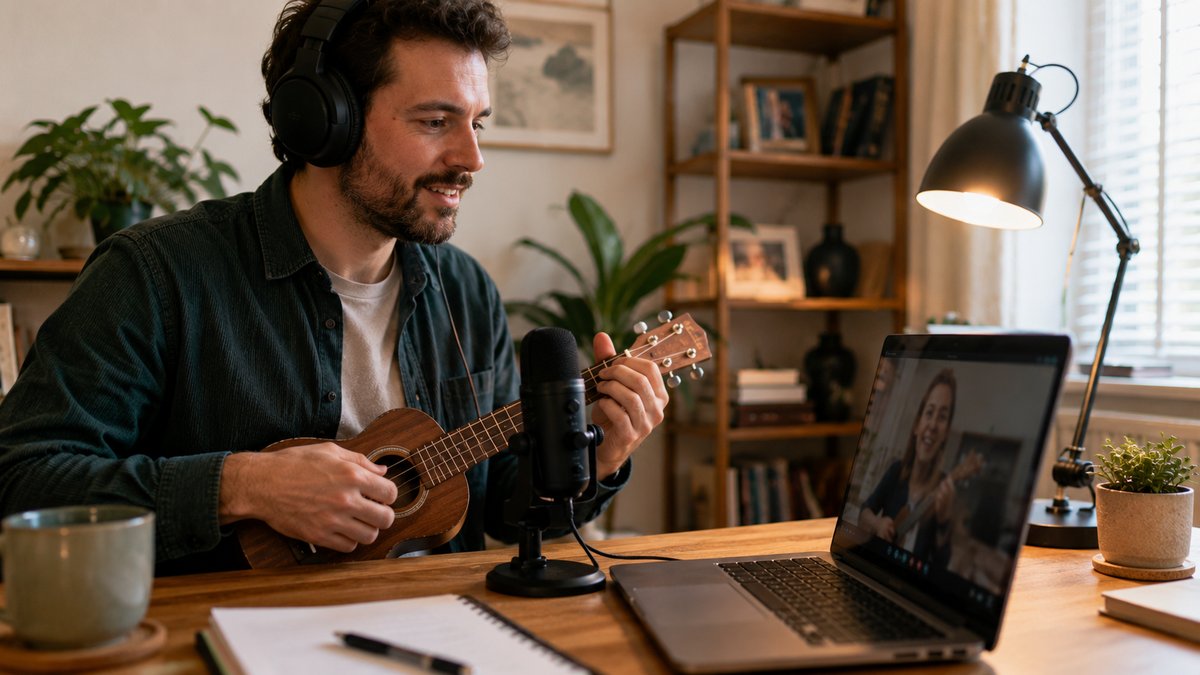
The Best Video Call Setup for Online Music Lessons (Zoom, Google Meet, and FaceTime)
Online music lessons work remarkably well, but only if your video call is set up for music, not just conversation. Every major platform is designed to make speech clear by smoothing out other sound, which is exactly the wrong thing for an instrument. The fixes are quick, and most of them are the same no matter which platform your teacher uses. Here’s the simple, universal setup, plus the one key tip for Zoom, Google Meet, and FaceTime.
This is a good one for teachers to send students before a first lesson, and for students to set up on their own.
The Universal Essentials (Any Platform)
These four things matter more than which app you use:
- Audio is everything. Turn off any “noise cancellation” or “noise suppression” feature. It’s built to remove background sound and will treat your instrument the same way, cutting and muffling your playing.
- Wear headphones. They prevent the echo loop that happens when your teacher’s sound comes out of your speakers and back into your microphone. This alone fixes most audio problems.
- Use a good microphone if you can. An external USB mic is the single biggest upgrade to how clearly your teacher hears you. Even built-in mics improve a lot once noise filtering is off.
- Mind your camera and light. Angle the camera so your hands and instrument are visible, not just your face, and light yourself from the front by facing a window or lamp.
A stable connection ties it together: wired ethernet if possible, and close other apps during the lesson.
Zoom: Turn On Original Sound
Zoom has the most music-friendly options of any platform. Use the desktop app, then enable Original Sound for Musicians and high-fidelity music mode in Settings → Audio, and set background noise suppression to Low. Toggle “Original Sound for Musicians” on at the start of each lesson. For the full walkthrough, see our Zoom settings for music lessons guide.
Google Meet: Turn Off Noise Cancellation
Google Meet runs in your browser with nothing to install. The key step is switching noise cancellation off (three-dot menu → Settings → Audio) so it stops filtering your instrument. Meet has no dedicated music mode, so headphones and a good mic matter a bit more. Full details are in our Google Meet for music lessons guide.
FaceTime: Keep It Simple
FaceTime is the easiest to use and the most limited to tune. There’s no music mode and no noise-cancellation toggle to turn off, so it applies more processing to your sound than Zoom or Meet. It works fine for casual lessons, especially between Apple devices, but for serious study Zoom or Google Meet give your teacher a clearer signal. To get the most from FaceTime: use headphones, sit in a quiet, well-lit room, keep your device steady on a stand, and stay close to strong Wi-Fi.
Is It a Settings Problem or a Connection Problem?
When a lesson isn’t working, it’s almost always one of two things, and they have different fixes, so a quick check tells you which:
- If your teacher can hear you but your instrument sounds muffled, thin, or cuts out on held notes. That’s a settings problem. Turn off noise cancellation/suppression, and on Zoom enable Original Sound, as described above.
- If the video freezes, the audio robots out or drops, or there’s a long delay. That’s a connection problem. Use the fixes below.
That way you (or your student) can usually self-diagnose without the teacher having to troubleshoot mid-lesson.
Fixing a Slow or Unstable Connection
Music is less forgiving of a shaky connection than conversation is, so a few minutes here pays off. Work through these in order:
- Use a wired ethernet connection instead of Wi-Fi if you possibly can. It’s the single biggest improvement.
- On Wi-Fi, get close to the router, minimize the walls between you and it, and use the 5 GHz network if it’s available.
- Close other apps, browser tabs, and background downloads.
- Ask others at home to pause streaming, gaming, and large downloads during the lesson.
- Turn off your camera if the audio breaks up: video uses the most bandwidth, and for music your sound matters most.
- Lower the video quality in your platform’s settings to free up bandwidth (Zoom: stop HD video; Google Meet: Settings → Video → standard definition).
- Restart your router before the lesson if it’s been running a long time.
- Run a quick speed test at fast.com. You only need a few Mbps of upload, and a stable connection beats a fast one.
- As a last resort, switch to your phone’s mobile hotspot if home internet is down.
How to Find a Music Teacher on Tunelark
Every music teacher on Tunelark is vetted for credentials, teaching experience, and ability to teach effectively online. Our roster covers every common instrument plus voice, with teachers across classical, jazz, pop, contemporary, and beyond.
To find your match:
1. Browse our music teachers and filter by instrument, style, or student age.
2. Read bios carefully. Look for teachers whose described approach matches your goals.
3. Book a trial lesson with two or three teachers whose profiles resonate.
4. After each trial, notice: did the teacher feel curious about you and clear about what they’d work on next? Both signals matter more than credentials.
The best music teacher for you isn’t the most credentialed or the most popular. It’s the one whose teaching style and personality fit how you learn. Tunelark makes that match easier to find.
Frequently Asked Questions
What is the best platform for online music lessons?
Zoom offers the most music-friendly audio settings (original sound and high-fidelity mode), so it’s often the best choice. Google Meet works well with noise cancellation turned off, and FaceTime is fine for casual lessons but has the fewest controls.
What’s the single most important setting for music on a video call?
Turn off noise cancellation or noise suppression. Every platform applies it by default, and it’s the main reason instruments sound muffled or cut out on video calls.
Do online music lessons actually work?
Yes: with the right audio setup, online lessons are highly effective. A good microphone, headphones, and disabled noise filtering let your teacher hear the detail they need to give useful feedback.
Should I use my phone or a computer for online music lessons?
A computer is usually better. It gives you a more stable connection and an easier camera angle to show your hands and instrument. If you use a phone or tablet, prop it on a stand so it stays steady.
What internet speed do I need for online music lessons?
Not much: a few Mbps of upload speed is plenty. A stable connection matters far more than a fast one. If your lesson freezes or drops, use a wired ethernet connection, get closer to your router, close other apps and downloads, and ask others at home to pause streaming. Turning off your camera also frees up bandwidth for clear audio.
Keep reading
About Jennifer Heath
I'm Jennifer Heath, VP at Tunelark and a lifelong singer. I joined the company in 2020 and oversee much of what makes Tunelark work for our students and our teachers. That includes hiring, training, and supporting our instructors, customer and student support, marketing, and the day-to-day operations of the business.
I started voice lessons at age 7, sang with professional choirs that toured internationally through my teens, and performed solo at competitions and community events across Texas before stepping away in my twenties to study other interests, including business management. I haven't performed professionally in years, but I'll happily take the microphone at a karaoke night. Music has been in me every day of my life. Being able to spend the last six years working inside an online music education company, while traveling the world full-time, has been a perfect fit.
I believe deeply that music belongs in every life. For the self-expression, the discipline, the comfort, and the simple joy of it.
The Tunelark blog is where we share what we've learned about online music lessons: how to choose an instrument and a teacher, what to expect from your first lesson, how the major platforms compare, and how to keep music going through the busier seasons of life. Practical, honest writing you can act on.
Who we are
Tunelark provides virtual 1-on-1 music lessons to learners
of all ages.
We remove the barrier of geography and connect learners and teachers — wherever they are. Our growing community of vetted, experienced music educators have expertise in a wide variety of instruments, genres, and skill levels. We are passionate about connecting each student with the perfect instructor.

