
Are Online Music Lessons Actually Good? An Honest Look
How Online Music Lessons Work (And Why They’re So Effective)
Not long ago, the idea of taking music lessons online would have seemed unusual. Today, it’s become one of the most popular and well-researched models for music education, embraced by students and teachers around the world. If you’re new to it, you might be wondering exactly how online music lessons work, and whether they’re really as effective as the traditional alternative.
The short answer is yes, they are. Here’s a closer look at why.
The Basic Setup
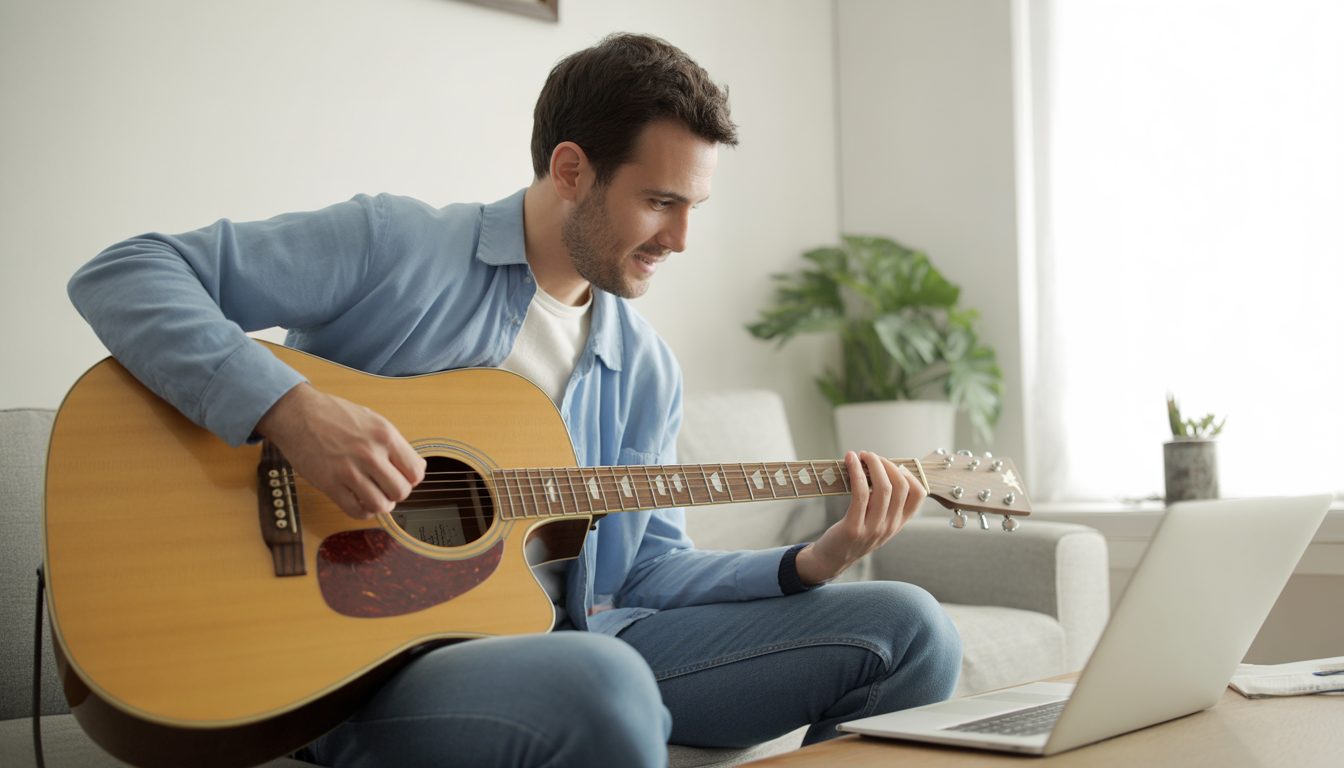
Online music lessons happen through video conferencing, typically Zoom, Google Meet, or a similar platform. You and your teacher connect at a scheduled time, see and hear each other in real time, and conduct a lesson just as you would in person, with the teacher demonstrating, giving feedback, and guiding your practice.
What you need to get started is minimal:
- A device with a camera and microphone (laptop, tablet, or desktop with webcam)
- A reliable internet connection: standard home broadband works well
- Your instrument, ready to play
- The video conferencing app your teacher uses (your teacher will let you know which one)
Most students are surprised by how quickly the online format begins to feel normal. Within a few lessons, the screen between you and your teacher fades into the background, and you’re simply focused on the music.
What a Typical Online Lesson Looks Like
A typical online music lesson follows much the same structure as any music lesson. It usually begins with a brief check-in: how was practice this week, any questions or struggles to address? : followed by work on whatever the student has been practicing.
The teacher listens carefully, watches your technique, and gives real-time feedback. If a specific technique needs demonstrating, the teacher plays it on their instrument so you can see and hear. Many teachers use a second camera angle to show their hands more clearly, or share their screen to display sheet music, diagrams, or notation software.
At the end of the lesson, the teacher typically assigns a practice plan (what to focus on, how to approach specific challenges) to guide the student’s work between sessions.
Why Online Lessons Are So Effective
Several factors make online music lessons particularly effective, some of which are genuine advantages over other formats.
Access to the best teachers. When you’re limited to teachers who live nearby, your options are constrained by geography. Online lessons remove that constraint entirely. You can work with a specialist in your exact instrument and style, regardless of where either of you lives. Students in smaller towns or rural areas have access to the same quality of instruction as students in major cities.
Consistency and flexibility. Online lessons are easier to fit into a busy life. No commute, no travel time, no logistics beyond opening an app. This makes it easier to maintain a consistent lesson schedule, and consistency is one of the biggest factors in musical progress.
Comfort of home. Many students, especially children and beginners, feel less self-conscious practicing and playing in their own space than in a teacher’s studio. This comfort can actually accelerate learning, particularly in the early stages when vulnerability is highest.
Recorded sessions. With permission from both parties, many online lessons can be recorded so students can review their teacher’s instructions and demonstrations between sessions. This is a genuine advantage that in-person lessons typically can’t offer in the same way.
What About Audio Quality?
This is the most common concern people have about online music lessons, and it’s a fair one. Video conferencing audio is processed and compressed, which can make it harder to hear subtle tonal nuances compared to live, in-room sound.
Experienced online music teachers have adapted their teaching to work within these limitations. They focus on what is clearly audible (rhythm, pitch accuracy, technique issues visible from the camera angle) and adjust their feedback accordingly. For most students at most levels, the audio quality of a standard video call is more than sufficient for productive, effective lessons.
For advanced students working on very nuanced tonal details, some teachers and students invest in better microphones and audio setups. But for the vast majority of students, the standard setup works perfectly well.
The Research Supports It
Studies conducted on online music instruction (including research from music education journals and university programs) have found that students in online lessons make comparable progress to those in in-person settings, with high rates of student and teacher satisfaction. The flexibility of the format increases lesson consistency, which has its own positive effect on outcomes.
Understanding how online music lessons work is the first step toward seeing why they’ve become a mainstream, preferred model for so many students and families. If you’ve been curious but hesitant, there’s every reason to give it a try.
How to Find a Good Music Teacher on Tunelark
When you’re ready to start lessons, the right teacher is what turns intention into consistent progress. Many Tunelark teachers specialize in exactly the kind of student you are.
1. Browse our teachers and filter by your chosen instrument.
2. Read bios. Look for teachers whose profile resonates with your specific goals. Generic bios are a yellow flag.
3. Book a trial lesson with one whose profile resonates.
After the trial, ask yourself: did the teacher seem genuinely interested in your goals, or were they running through a generic curriculum?
The right teacher changes everything. The trial lesson is there to find them.
Frequently Asked Questions
Are online music lessons as good as in-person?
For most students and most instruments, yes. The audio and video quality are now strong enough that experienced teachers can teach at a high level remotely. The biggest factor remains the teacher, not the format.
What instruments work best for online lessons?
All of them, with slight nuances. Voice, piano, guitar, and most instruments work very well. Drums and very loud instruments need decent microphone handling, which most platforms now manage well.
What if the audio quality is bad?
Most issues come from internet connection or built-in microphones. A simple USB microphone and a wired internet connection fix most quality problems for under $100 total.
Can young children learn online?
Yes, with parent support for ages 5–8. Many young students thrive online: the comfortable home environment can help anxious learners. Look for teachers experienced with online kid lessons.
How can I make sure my online lesson goes smoothly?
Test your camera and microphone before the lesson, sit in a well-lit space, position the camera to show your hands and instrument, and have your music ready. Five minutes of prep makes a difference.
Keep reading
About Jennifer Heath
I'm Jennifer Heath, VP at Tunelark and a lifelong singer. I joined the company in 2020 and oversee much of what makes Tunelark work for our students and our teachers. That includes hiring, training, and supporting our instructors, customer and student support, marketing, and the day-to-day operations of the business.
I started voice lessons at age 7, sang with professional choirs that toured internationally through my teens, and performed solo at competitions and community events across Texas before stepping away in my twenties to study other interests, including business management. I haven't performed professionally in years, but I'll happily take the microphone at a karaoke night. Music has been in me every day of my life. Being able to spend the last six years working inside an online music education company, while traveling the world full-time, has been a perfect fit.
I believe deeply that music belongs in every life. For the self-expression, the discipline, the comfort, and the simple joy of it.
The Tunelark blog is where we share what we've learned about online music lessons: how to choose an instrument and a teacher, what to expect from your first lesson, how the major platforms compare, and how to keep music going through the busier seasons of life. Practical, honest writing you can act on.
Who we are
Tunelark provides virtual 1-on-1 music lessons to learners
of all ages.
We remove the barrier of geography and connect learners and teachers — wherever they are. Our growing community of vetted, experienced music educators have expertise in a wide variety of instruments, genres, and skill levels. We are passionate about connecting each student with the perfect instructor.

