
Beginner Drum Tips: What Every New Drummer Should Know
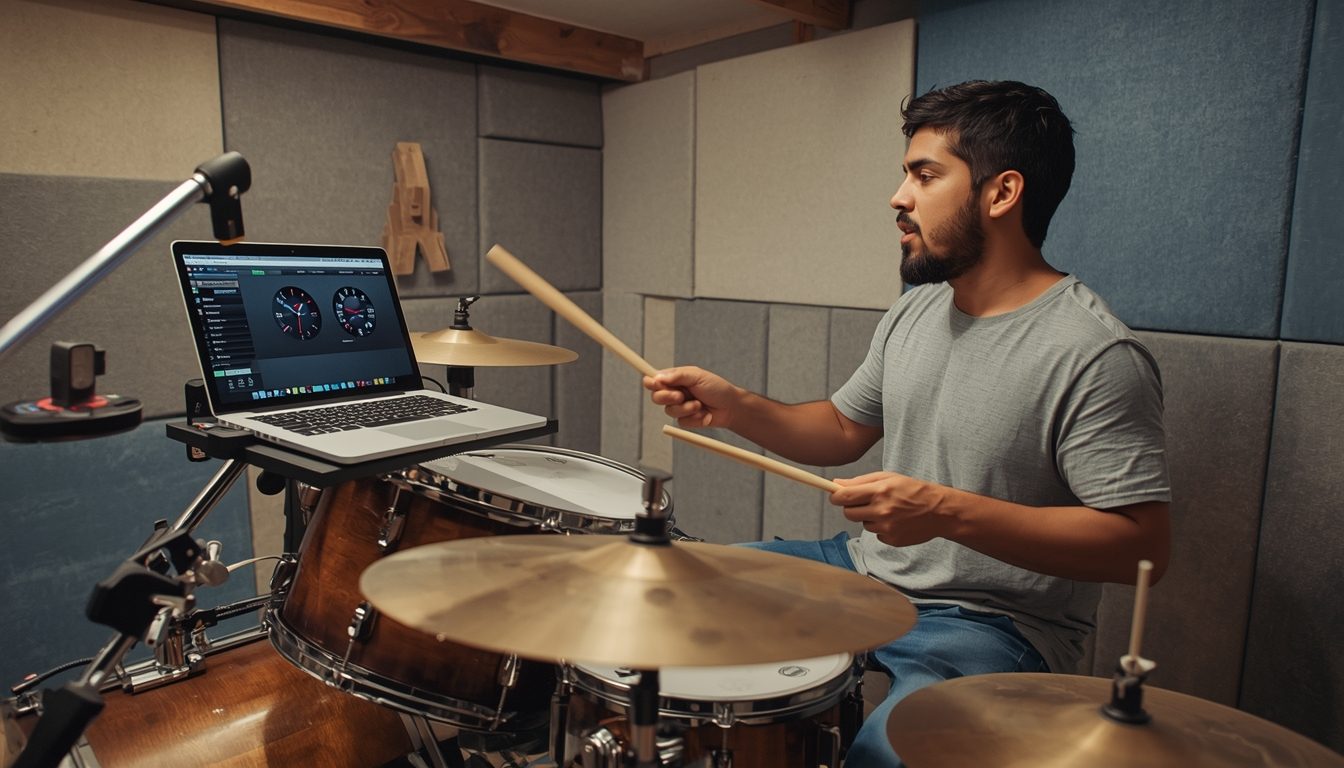
Beginner Drum Tips: What Every New Drummer Should Know
The first ninety days on drums are mostly about a few unglamorous things: how you hold the sticks, how you sit, and a small handful of patterns you play slowly and correctly until they stop feeling like a thought. Get those right and the rest of drumming opens up. Get them wrong and you will be undoing habits for years.
This is a short collection of beginner drum tips aimed at adult beginners and parents of new drum students. None of it is fancy. All of it matters.
Holding the Sticks: The Matched Grip
The first thing any new drummer needs to fix is the grip. Most people, left to their own devices, grab a drumstick like they grab a hammer, fist closed, knuckles up. That works for a hammer. It does not work for a drum.
The matched grip is what nearly every modern drum teacher will start you with. Both hands hold the stick the same way. The stick rests in the crook between your thumb and the side of your index finger, roughly a third of the way up from the back end of the stick. That contact point is your fulcrum, the point the stick pivots around when you play.
Your thumb sits flat along the stick on one side. Your other fingers wrap loosely around the other side. The grip is firm enough that the stick will not fly out, and loose enough that the stick can bounce freely off the drum head.
This last part is the part beginners miss. A drumstick wants to bounce. If you grip it tightly, you kill the bounce, and every stroke becomes muscular work. A good grip lets the stick do half the playing for you. If your forearms are sore after a thirty-minute practice, your grip is too tight.
Posture at the Kit
Drumming is a full-body activity, and most early problems trace back to how you are sitting.
Set the throne (the drum stool) so that your thighs slope very slightly downward toward your knees. Your knees should be at about a ninety-five-degree angle, not a hard ninety. Your feet should rest flat on the pedals with your heels relaxed.
Sit on the front half of the throne, not the back. Your back should be roughly upright, not slumped, but not military-straight either. Imagine someone has gently pulled a string up from the crown of your head.
Your snare drum should sit between your knees, tilted slightly toward you, with the top head at roughly belly-button height. Your hi-hat should be just to the left (for right-handed players) at about the same height as the snare. The crash, ride, and toms should each be reachable without leaning.
A surprising number of beginner drum problems (sore shoulders, sore back, weak left hand, missed cymbal hits) come from a throne that is too low or too high. If you remember nothing else, set the throne so your thighs slope slightly down. That single adjustment fixes more bad habits than any other.
Your First Five Beats
You do not need to learn fifty patterns. You need to learn five, and you need to play them slowly enough that they sound clean.
1. Quarter notes on the hi-hat. Just the hi-hat, four even hits per bar, with a metronome. This is your foundation.
2. Quarter notes on the hi-hat with kick on 1 and 3 and snare on 2 and 4. This is the basic rock beat. It is the building block of an enormous percentage of popular music.
3. Eighth notes on the hi-hat with the same kick and snare pattern. Eight hi-hat hits per bar instead of four.
4. Adding a kick on the “and” of 3. This small variation turns the basic rock beat into something that sounds more like an actual song.
5. A simple eight-bar phrase with a fill on the last bar. The fill can be as simple as four notes around the toms.
Play each of these for ten minutes at a slow tempo (around 70 bpm) before you speed up. Use a metronome every single time. The thing that separates drummers who feel good from drummers who feel bad is time, and time is something you have to build deliberately. There is no shortcut.
For more on building a sustainable home routine, see our guide on how to practice music at home.
Practicing Without Annoying Everyone
The volume problem is real. An acoustic kit, played at a normal practice volume, is loud enough to upset a downstairs neighbor and a partner in the next room. There are three honest paths through this.
Electronic kit. A decent beginner electronic kit (Alesis Nitro, Roland TD-02K, Yamaha DTX402) runs four to seven hundred dollars and lets you practice with headphones. The pads do not feel exactly like real drumheads, but they are close enough that the technique transfers. For most apartment-dwellers and parents of beginning drummers, this is the right call.
Mesh-head practice kit or low-volume cymbals. If you already have an acoustic kit, you can swap the drumheads for mesh heads (much quieter) and add low-volume cymbals. The kit then plays at roughly conversational volume.
Practice pad work. A simple rubber practice pad ($25-$40) lets you do grip, stroke, and rudiment work silently. This is not a substitute for kit time, but it can carry you through times when you cannot make noise. A surprising amount of high-level drumming work happens on a practice pad.
If you are working without an acoustic kit at all, our guide to online drum lessons without an acoustic kit covers the full setup options in more detail.
What Not to Learn Wrong
A few habits, picked up early, are very hard to unlearn later. Among the most important beginner drum tips: actively avoid these.
- Playing only loud. Beginners default to slamming the drums. Learn to play softly from the start. Dynamic control is far harder to add later.
- Ignoring your left hand (or right, if you are left-handed). Your non-dominant hand needs equal practice. Most beginners under-train it, and it shows up in every fill for years.
- Speeding up to “make it sound right.” If a pattern only sounds good at a fast tempo, you do not actually know it yet. Slow it down. The metronome is not lying to you.
- Skipping the rudiments. Single strokes, double strokes, and paradiddles are the alphabet of drumming. Spend a few minutes on them every practice. They feel boring early and pay off forever.
- Practicing without ear protection. Drums are loud. Use musician’s earplugs (around twenty to thirty dollars for a decent pair). Your hearing is non-renewable.
How to Find a Good Music Teacher on Tunelark
A good drum teacher will catch grip, posture, and timing problems in your first lesson. Problems that are very hard to self-diagnose. For new drummers, this is worth more than almost any other piece of gear.
1. Browse our teachers and filter by drums.
2. Read bios. Look for teachers who mention working with beginners and who clearly understand both acoustic and electronic kit setups.
3. Book a trial lesson with one whose profile resonates.
4. After the trial, ask yourself whether the teacher actually watched your grip and posture, or just gave you patterns to copy.
If this is your first online lesson, our guide on what to expect in a first online music lesson will save you some setup time.
Frequently Asked Questions
Can I really learn drums online?
Yes. Online drum lessons work well, especially once you have a basic kit (electronic or acoustic) and a stable camera angle. A teacher can see your grip, your posture, and your stick height clearly through video, and most of the early curriculum does not depend on being in the same room.
Do I need a full kit to start?
No. Many drummers start with a practice pad and a pair of sticks, then move to a kit once they are sure they want to commit. A practice pad costs about thirty dollars and covers grip, stroke, and rudiment work for the entire first month or two.
How long until I can play a real song?
Most beginning drummers can play along with a simple rock or pop song, recognizably, within four to six weeks of starting. Cleanly and at full speed takes longer. The basic rock beat is the entry point, and an enormous amount of popular music sits on top of it.
Are drums hard on your body?
They can be if your setup is wrong. With a properly adjusted throne, good posture, and a relaxed grip, drumming is no harder on the body than most other instruments. If something hurts during practice, stop and figure out which adjustment is causing it.
What size sticks should I get?
5A is the standard all-purpose size and the right starting point for almost every beginner. They are widely available, balanced for most styles, and what most drum teachers will recommend until you know your preferences. You can experiment with other sizes later.
Looking for an online drum teacher? See our full Online Drum Lessons page for everything you need to know about getting started.
Keep reading
About Jennifer Heath
I'm Jennifer Heath, VP at Tunelark and a lifelong singer. I joined the company in 2020 and oversee much of what makes Tunelark work for our students and our teachers. That includes hiring, training, and supporting our instructors, customer and student support, marketing, and the day-to-day operations of the business.
I started voice lessons at age 7, sang with professional choirs that toured internationally through my teens, and performed solo at competitions and community events across Texas before stepping away in my twenties to study other interests, including business management. I haven't performed professionally in years, but I'll happily take the microphone at a karaoke night. Music has been in me every day of my life. Being able to spend the last six years working inside an online music education company, while traveling the world full-time, has been a perfect fit.
I believe deeply that music belongs in every life. For the self-expression, the discipline, the comfort, and the simple joy of it.
The Tunelark blog is where we share what we've learned about online music lessons: how to choose an instrument and a teacher, what to expect from your first lesson, how the major platforms compare, and how to keep music going through the busier seasons of life. Practical, honest writing you can act on.
Who we are
Tunelark provides virtual 1-on-1 music lessons to learners
of all ages.
We remove the barrier of geography and connect learners and teachers — wherever they are. Our growing community of vetted, experienced music educators have expertise in a wide variety of instruments, genres, and skill levels. We are passionate about connecting each student with the perfect instructor.

