
Online Drum Lessons: How They Actually Work (Even Without an Acoustic Kit)
Online Drum Lessons: How They Actually Work (Even Without an Acoustic Kit)
The most common reason adults give for not taking drum lessons is “I don’t have a drum kit.” This is almost never the real obstacle. Modern online drum instruction has solved the equipment problem in several different ways, and the rate of progress for online drum students is no slower than for in-person students.
Here’s how online drum lessons actually work, what you need to participate, and what to expect at each stage.
You Don’t Need an Acoustic Kit
For a beginner (and for many intermediate students) there are three good alternatives to a full acoustic kit:
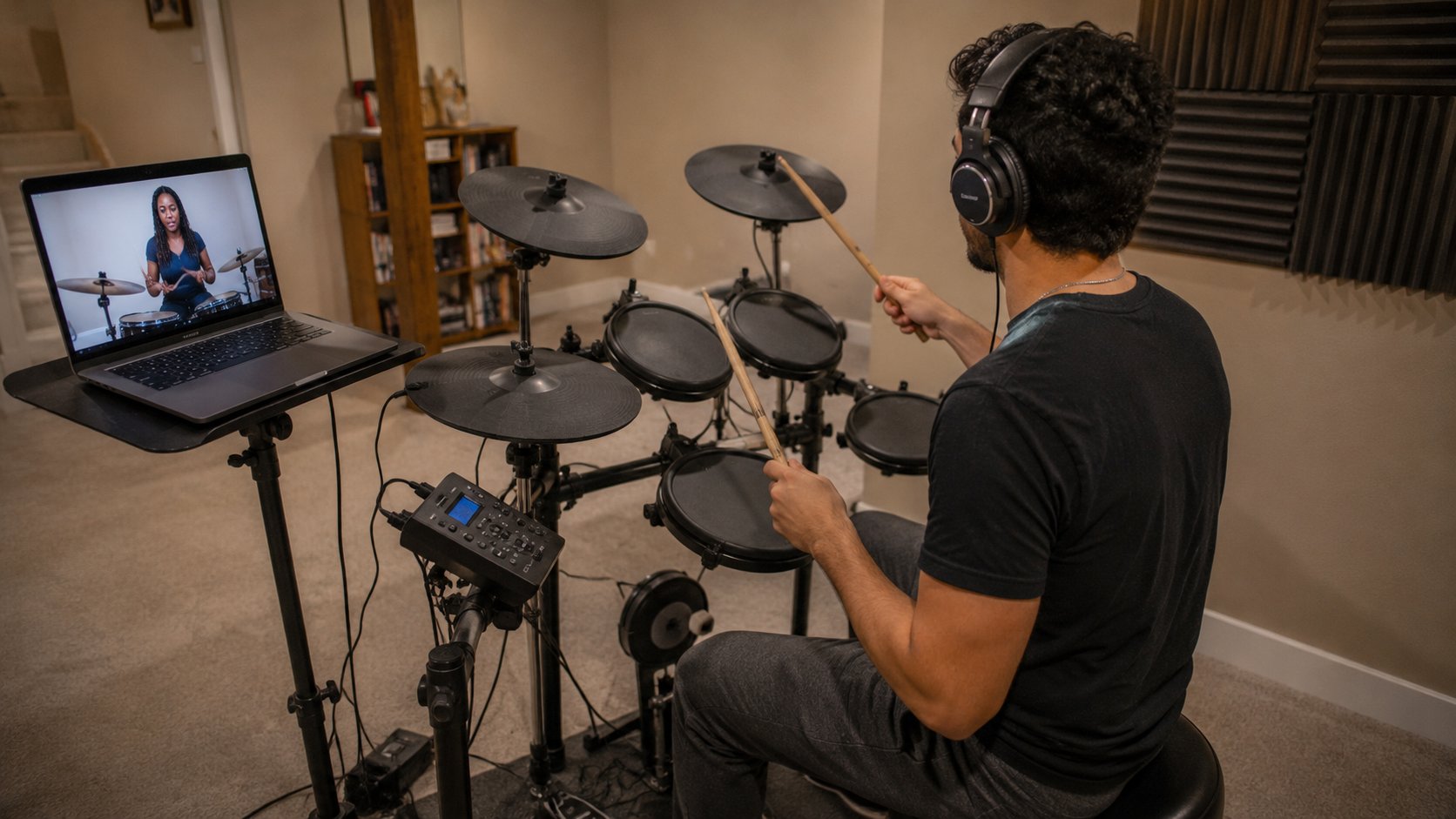
Electronic drum kit. The dominant choice for online students. A mid-range kit (Alesis, Roland, Yamaha) runs $400-$1200, fits in a corner, runs on headphones, and produces a real-time response that mirrors acoustic-drum playing closely enough that all foundational technique transfers cleanly.
Practice pad and stool. For students focused on rudiments, technique, and reading, a single rubber practice pad and a stool can carry you through the first several months of lessons. This is the cheapest entry point at under $50.
Tabletop drum trainer. A folded-up pad that simulates the four-piece kit layout. Roland TD-1KV and similar trainers cost $200-$400 and give you the four-limb coordination experience without the room or noise of a full kit.
Whichever you choose, the lesson experience is the same. Your teacher sees your hands and your kit through your webcam, hears your audio over a decent microphone, and works on what you’d work on in person.
Why Drum Lessons Work Online
The teaching of drums is mostly about three things: time, technique, and limb coordination. All three are visible and audible over video. Your teacher can see your stick grip, your foot motion, your posture. They can hear your timing relative to a metronome. They can spot the tension in your shoulders that’s making your right hand drag.
What in-person drum lessons offer that online doesn’t is the chance to play together in the same room. That’s real, but it’s also a luxury most beginners don’t need until they’re working on ensemble playing, which is years into the journey.
What to Expect by Level
Beginner (months 0-6). Stick grip, basic single-stroke and double-stroke rolls, simple eighth-note rock beats, learning to read drum notation, playing along to slow tracks. The work feels small but adds up fast.
Early intermediate (months 6-18). All four limbs working independently. Sixteenth-note grooves, basic shuffle, simple fills. You can play along to most rock and pop songs at moderate tempos. Your timing is reliable enough that you start to enjoy listening to yourself.
Intermediate (year 2-3). Linear drumming, basic odd time signatures, jazz comping basics, more complex fills and transitions. You can sit in on a jam session and not embarrass yourself.
Advanced (year 3+). Genre-specific vocabulary (jazz independence, gospel chops, Latin rhythms, metal endurance). This is where most serious drummers settle into stylistic specialization.
What an Online Lesson Looks Like
A typical 45-minute online drum lesson runs through warm-ups with the metronome, a technique focus (whatever your teacher has you working on this week), review of last week’s homework, and introduction of new material, usually a groove, a rudiment, or a piece. Your teacher demonstrates on their kit, you copy on yours, and you go back and forth until the pattern is in your hands.
The technology rarely gets in the way. Modern video conferencing handles drum audio better than people expect, and dedicated music-lesson apps reduce latency further.
Equipment Beyond the Kit
To get the most out of online drum lessons:
- A webcam angled to show your hands and the kit, not your face. Your teacher cares about what you’re doing, not what you look like.
- Headphones for the electronic kit. Wired headphones avoid latency issues.
- A music stand with sheet music or a tablet. Drum sheet music is part of every serious drum education.
- A metronome app. Soundbrenner, Pro Metronome, or your kit’s built-in metronome will work.
Total setup cost for a beginner: $500-$800 if you go with a basic electronic kit and headphones. Less if you start with a practice pad.
How to Find a Drum Teacher on Tunelark
Tunelark vets every drum teacher for credentials, teaching experience, and ability to teach effectively online. To get started:
1. Browse our drum teachers and filter for drums.
2. Read bios. Look for teachers who describe their teaching approach and the styles they specialize in.
3. Book a trial lesson with one whose profile resonates.
4. After the trial, ask yourself: did the teacher’s style and energy fit how you want to learn? Drum teaching has a lot of personality variation. Find someone whose feel works for you.
Drumming online is genuinely effective. The barrier most people imagine is much smaller than they think, and the rewards of finally learning the instrument are enormous.
Frequently Asked Questions
Can I really learn drums without an acoustic kit?
Yes. Electronic kits and practice pads cover all foundational technique. Most online drum students never own an acoustic kit and progress just as well as those who do.
Will my neighbors hear me?
If you use an electronic kit with headphones, no. Practice pads are also nearly silent. Acoustic kits in apartments are the only setup that creates noise issues.
How long before I can play along to real songs?
Most students can play along to slow rock songs within three months and to moderate-tempo songs within six months. Complex grooves take longer, but the satisfaction of playing along to actual music arrives early.
Do I need to read music to take drum lessons?
No. Many drum teachers start with rhythmic vocabulary and reading taught together. By the end of your first year, you should be reading basic drum notation comfortably.
What’s the minimum age for drum lessons?
Most teachers will start students around age 7 or 8. Younger students can do simple rhythm work, but the four-limb coordination required for kit playing takes some physical maturity.
Looking for an online drum teacher? See our full Online Drum Lessons page for everything you need to know about getting started.
Keep reading
About Jennifer Heath
I'm Jennifer Heath, VP at Tunelark and a lifelong singer. I joined the company in 2020 and oversee much of what makes Tunelark work for our students and our teachers. That includes hiring, training, and supporting our instructors, customer and student support, marketing, and the day-to-day operations of the business.
I started voice lessons at age 7, sang with professional choirs that toured internationally through my teens, and performed solo at competitions and community events across Texas before stepping away in my twenties to study other interests, including business management. I haven't performed professionally in years, but I'll happily take the microphone at a karaoke night. Music has been in me every day of my life. Being able to spend the last six years working inside an online music education company, while traveling the world full-time, has been a perfect fit.
I believe deeply that music belongs in every life. For the self-expression, the discipline, the comfort, and the simple joy of it.
The Tunelark blog is where we share what we've learned about online music lessons: how to choose an instrument and a teacher, what to expect from your first lesson, how the major platforms compare, and how to keep music going through the busier seasons of life. Practical, honest writing you can act on.
Who we are
Tunelark provides virtual 1-on-1 music lessons to learners
of all ages.
We remove the barrier of geography and connect learners and teachers — wherever they are. Our growing community of vetted, experienced music educators have expertise in a wide variety of instruments, genres, and skill levels. We are passionate about connecting each student with the perfect instructor.

