
Beginner Cello Tips: What Every New Cellist Should Know
Beginner Cello Tips: What Every New Cellist Should Know
Starting cello is a quietly ambitious decision. It is a big instrument that asks for time, space, and patience, and it rewards all three in ways that few other instruments do. The sound, when you get it right, is one of the closest to the human voice in all of music.
These beginner cello tips won’t make the first months easy. Nothing makes the first months easy. But getting the foundation right will save you from undoing bad habits later, and that alone can shave years off your timeline.
Why Cello Is a Long Game
Cello takes longer to sound good than guitar, longer than piano, and the early curve is comparable to violin. Three things conspire against you in the first months: there are no frets, the bow is its own instrument, and the posture demands are significant. You are holding a four-foot wooden instrument against your body while coordinating two hands doing very different jobs.
The upside is that cello rewards patience in ways many instruments do not. Tone develops over years, but it deepens. Intonation gets easier as your ear sharpens. The repertoire opens up beautifully as you gain skill, with some of the most loved music in the Western tradition written for cello.
If you go into it expecting a slow build, you’ll do fine. If you go in expecting to sound like Yo-Yo Ma in a year, you’ll quit by month four. Setting realistic expectations is the first step, and our home practice guide is a good companion for the long haul.
Posture and Setup From Day One
More than for almost any other instrument, cello posture is the foundation everything else sits on. Get it right early and the rest of your development will be much smoother.
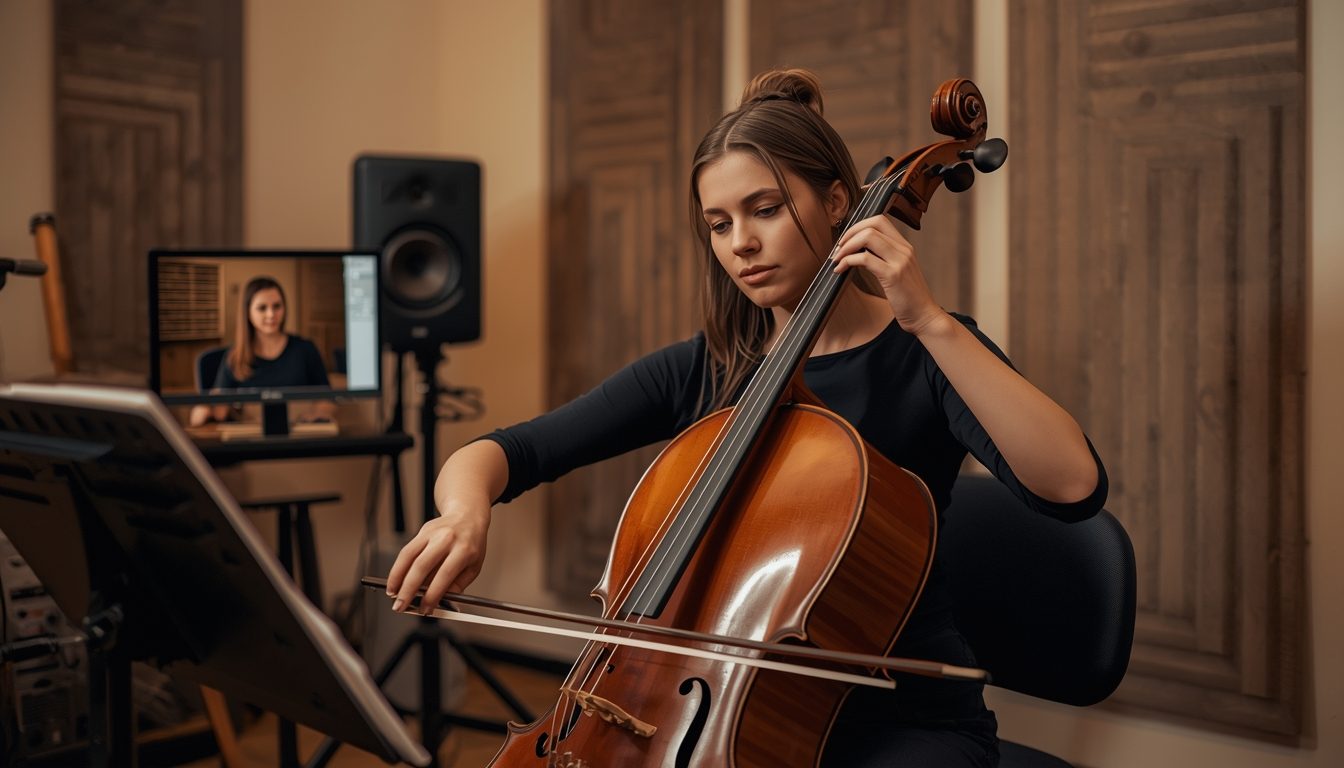
Sit on the front half of a firm, flat chair: no slouching backward, feet flat on the floor. Knees should be a few inches lower than your hips. The cello rests between your knees, with the lower bout against your inner thighs. The endpin should be adjusted so the upper edge of the cello sits roughly at your sternum and the C-string peg is just behind your left ear.
The cello should be supported by three points of contact: your knees, your sternum, and the endpin into the floor. It should not be clamped between your knees, and it should not lean heavily on you. If you let go with both hands, the cello should mostly stay put.
Common posture mistakes that cause trouble within months:
- Sitting too far back in the chair, which collapses the lower back and tilts the cello forward.
- Setting the endpin too short, which forces your shoulders up to reach the strings.
- Pulling the cello too far to the left, which puts strain on the left shoulder.
- Hunching forward toward the fingerboard. You should look down at it with your eyes, not your whole upper body.
A first lesson where the teacher spends fifteen minutes on how you sit and hold the cello is a teacher who knows what they are doing. Don’t be impatient with that work. Our piece on what to expect in your first online music lesson covers what a good early lesson looks like in general terms.
Bow Hold and Bow Distribution
The bow is half the instrument. New cellists often pour all their attention into the left hand and forget that tone (the actual sound that comes out of the cello) lives almost entirely in the right hand.
The bow hold should feel relaxed, not gripped. Thumb bent under the frog, fingers draped over the stick, ring finger and pinky resting lightly. The pinky in particular should not be locked straight. That’s a tension signal you’ll regret in six months. Beginners often hold the bow far too tight in the first weeks. If your knuckles are white, ease up.
Bow distribution is the other thing to learn early. Long notes need long, even bow strokes, using most of the bow’s length at a steady speed. Short notes use less bow. Beginners almost always use too little bow on long notes (running out at the tip) and too much on short notes (gobbling up bow length they didn’t need). Watch yourself in a mirror or on video. The bow should be moving in a straight line, perpendicular to the strings, and traveling at the speed the music needs.
A few useful early bow exercises:
- Long, slow open-string bows. Whole bow, frog to tip, then back. Aim for an even tone the entire way.
- “Bow planes” practice: moving between strings smoothly with just the right arm. The cello has four different bow planes, and getting between them cleanly is a year-long project.
- Détaché practice: separate, even bows on a scale. Not exciting, but the cleanest path to control.
The Left Hand and Intonation
The left hand on cello is doing two jobs at once: pressing the string firmly enough to produce a clear note, and placing the finger precisely enough that the note is in tune. Either job alone is hard. Together they take months to coordinate.
In first position, the four fingers cover roughly a whole step each on the lower strings (with some half-step exceptions). The spacing is wider than violin and narrower than bass. Your hand will adapt, but it adapts faster if you train it intentionally with scales and finger patterns, not just by playing tunes.
Intonation work that pays off:
- Practice slowly with a drone. A drone on the bottom note of the key gives your ear a reference and trains it to hear when you’re off.
- Stop on each note. Don’t rush past notes that feel wrong. If a note is sharp or flat, find the right placement before you move on.
- Use open strings as reference. Many notes on the cello have an open-string equivalent (an A on the D-string sounds the same as the open A-string). Use those moments to check your tuning.
- Sing the line first. If your ear knows what the note should sound like before your finger lands, intonation gets dramatically more accurate.
The left thumb should rest lightly behind the neck, opposite the middle finger. Squeezing the thumb against the neck is one of the most common early-cellist tension habits, and it limits your ability to move freely. A relaxed thumb is the goal from day one.
Practice Habits That Build Tone
Cello tone is built slowly, and the practice habits you build in the first year shape the tone you have at year five.
Practice slowly, especially with the bow. Slow bowing reveals every tone flaw: the bow speed wobbling, the contact point drifting, the pressure too heavy or too light. Slow bowing fixes them.
Listen with intention. Sit with your cello and just play long open-string notes. Don’t read music. Don’t think about what’s next. Listen to the sound and ask whether it’s full, clean, and even. This is how cellists learn what good tone is.
Record yourself. A phone recorder is enough. The sound coming out of your cello is not the sound you hear while playing it. The recording is closer to what listeners hear. Recording weekly is one of the fastest ways to improve tone without a teacher in the room.
Practice short and daily. Twenty to thirty minutes a day, every day, beats long weekend sessions. Cello technique consolidates with frequent contact. Long gaps undo a meaningful amount of work.
How to Find a Cello Teacher on Tunelark
A good cello teacher early on is worth their weight in nylon strings. The habits a beginner builds in the first six months are stubborn, and a teacher who watches your setup carefully will save you a great deal of corrective work later.
1. Browse our teachers and filter by your chosen instrument.
2. Read bios. Look for teachers who explicitly mention working with beginners and who describe their pedagogy in concrete terms.
3. Book a trial lesson with one whose profile resonates.
4. Pay attention to whether the teacher gives feedback on your sitting, breathing, and bow hold, not just your notes.
The right teacher can make the first year of cello feel like building something meaningful. The wrong one can make it feel like flailing in slow motion. Take the time to find someone you trust. Our overview of the best online cello lessons goes deeper on what to look for.
Frequently Asked Questions
Is cello harder than violin?
The early curve is similar. Both have no frets, both need bow control, both require careful posture. Cello posture is arguably more demanding because of the instrument’s size. Long-term, the two are comparable in difficulty.
Do I need to buy a cello to start, or can I rent?
Renting is a smart way to start. A good rental from a music shop will get you through your first year or two while you decide if cello is for you. Once you commit, an outright purchase makes sense.
How big should my cello be?
Adults play 4/4 (full-size). Children play smaller fractional sizes (1/2, 3/4, and so on) based on their height and arm length. A teacher or a reputable string shop can size a child correctly.
Can I practice cello in an apartment?
Yes, with some considerations. Cello is loud: not as loud as drums, but louder than guitar. A practice mute (a small rubber device that clips onto the bridge) reduces volume significantly for late-night work. Otherwise, normal practice during reasonable hours is fine in most apartments.
How long until I sound decent?
Most beginners with daily practice and a good teacher will be producing clean, in-tune notes on simple pieces within six to nine months. Genuinely lovely tone on a piece of real repertoire is usually a two-to-three-year project.
Keep reading
About Jennifer Heath
I'm Jennifer Heath, VP at Tunelark and a lifelong singer. I joined the company in 2020 and oversee much of what makes Tunelark work for our students and our teachers. That includes hiring, training, and supporting our instructors, customer and student support, marketing, and the day-to-day operations of the business.
I started voice lessons at age 7, sang with professional choirs that toured internationally through my teens, and performed solo at competitions and community events across Texas before stepping away in my twenties to study other interests, including business management. I haven't performed professionally in years, but I'll happily take the microphone at a karaoke night. Music has been in me every day of my life. Being able to spend the last six years working inside an online music education company, while traveling the world full-time, has been a perfect fit.
I believe deeply that music belongs in every life. For the self-expression, the discipline, the comfort, and the simple joy of it.
The Tunelark blog is where we share what we've learned about online music lessons: how to choose an instrument and a teacher, what to expect from your first lesson, how the major platforms compare, and how to keep music going through the busier seasons of life. Practical, honest writing you can act on.
Who we are
Tunelark provides virtual 1-on-1 music lessons to learners
of all ages.
We remove the barrier of geography and connect learners and teachers — wherever they are. Our growing community of vetted, experienced music educators have expertise in a wide variety of instruments, genres, and skill levels. We are passionate about connecting each student with the perfect instructor.

