
What Beginning Music Lessons Are Really Like for Adults
What Beginning Music Lessons Are Really Like (For Adults Worried About Embarrassment)
Most adults who consider music lessons and don’t pull the trigger cite the same reason quietly: they’re embarrassed. Embarrassed about being a beginner. Embarrassed about being bad at first. Embarrassed about being seen (and heard) making the awkward early sounds that every musician makes. This embarrassment keeps thousands of would-be adult musicians on the sidelines for years.
Here’s the honest truth about what adult beginner lessons are actually like, and why the embarrassment is almost always smaller in practice than in anticipation.
What You’re Actually Imagining vs. What Actually Happens
The mental image most adults have of starting music lessons goes something like this: you walk into a room, sit down, play badly in front of a serious-faced teacher, and feel exposed and stupid.
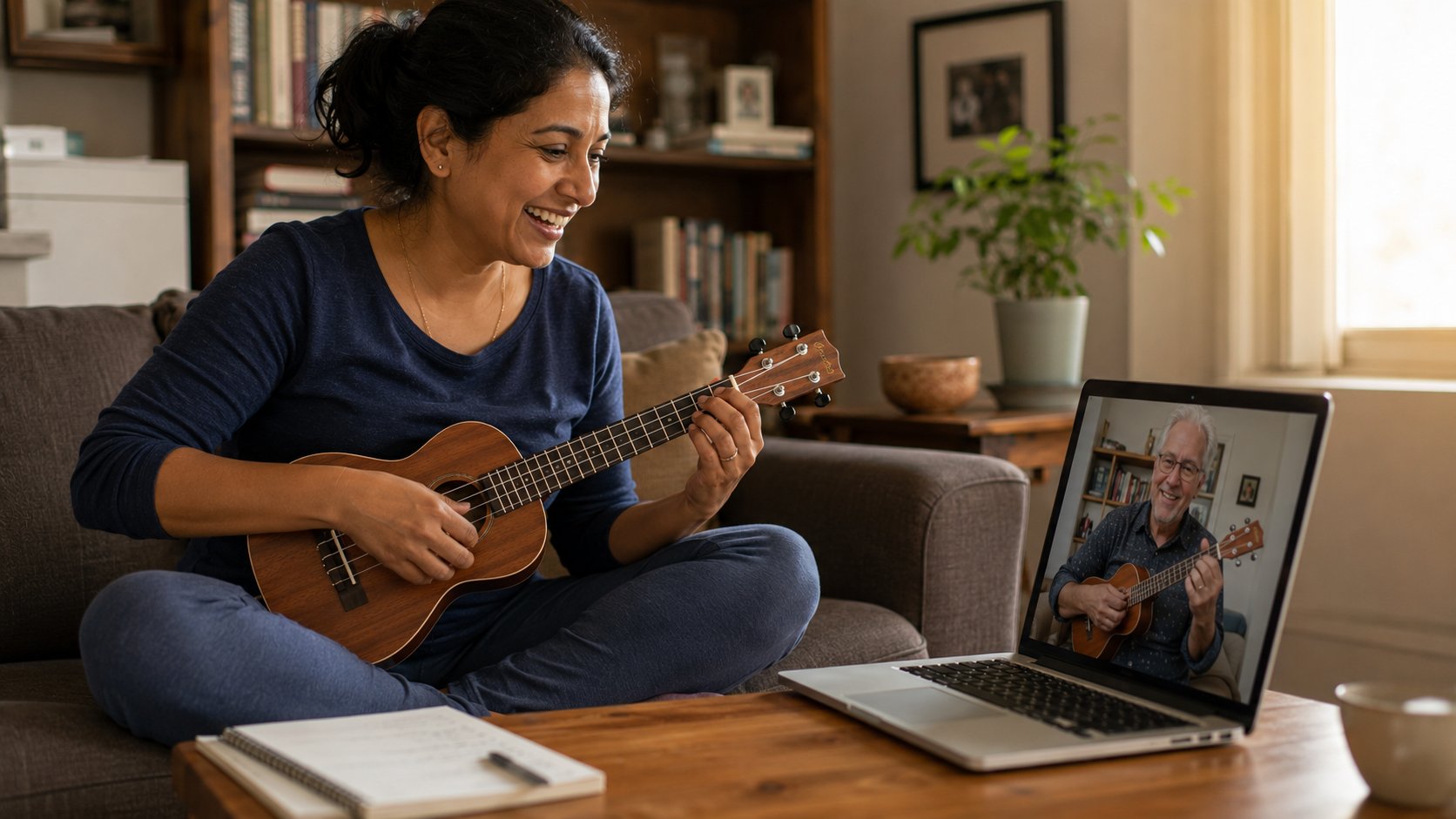
What actually happens: you log into a video call, the teacher introduces themselves, you talk about why you’re here and what you want to learn, you try a few things, the teacher gives gentle, specific feedback, and the lesson ends with you both having a sense of next steps. It’s far more conversational and less performative than the imagined version.
The first lesson is mostly diagnostic and getting-to-know-you. There’s almost no pressure to play well: the teacher wants to understand where you are, what you want, and how you learn. That’s the whole job of the first lesson.
What Teachers Actually Think About Adult Beginners
A few honest truths from the teacher’s perspective:
They want adult beginners. Teaching adults is a different kind of work than teaching kids, usually richer, more conversational, and more rewarding. Most teachers who advertise lessons online actively want adult students.
They’ve seen every level. Whatever you’re worried about (being too bad, being too old, having no rhythm, having a bad voice) they’ve worked with students at exactly your level dozens of times. You are not the worst they’ve heard. You’re not even close.
They’re not judging you the way you fear. Teachers see beginner work as the raw material they get to shape. Your awkward early playing is interesting to them, not embarrassing. They’re looking at how to help, not whether you’re worthy.
They get frustrated by students who hold back from embarrassment. A student who plays tiny and hidden is harder to teach than one who plays out, even badly. Teachers actively want you to take risks in the lesson. That’s where the learning happens.
The Specific Embarrassments and Why They Pass
Several common worries that are real but smaller than they feel:
“I’ll sing badly and feel humiliated.” Voice teachers spend their careers working with beginners who think they can’t sing. Your sound in the first lesson is not what they’re judging. They’re looking for what your voice can do, not how good it currently sounds.
“I’ll struggle with simple things and feel stupid.” This is universal among adult beginners. The teacher expects it. Within a few weeks, the things that felt impossibly hard become automatic, and you’ll wonder why they ever seemed so difficult.
“My fingers won’t do what I tell them.” Universal for the first few weeks on any instrument. It’s a motor learning issue, not a personal failing. It resolves with practice.
“I’ll cry in front of my teacher.” Some adults do, occasionally. Voice teachers in particular see emotional moments because the voice is so connected to identity. A good teacher handles this professionally and kindly. Many of these moments end up being the most meaningful parts of the learning.
Why Online Lessons Are Easier for the Anxious
Online lessons specifically reduce the embarrassment factor for several reasons:
- You’re in your own space. Your home, your instrument, your environment. You’re not on someone else’s turf.
- The physical distance lowers the stakes. Being on a screen feels slightly less exposing than being in the same room.
- You can record the lesson and review it privately later. Many breakthroughs happen on second listen, when the in-the-moment embarrassment is gone.
- It’s easier to switch teachers if the fit isn’t right. No awkward in-person dynamic if you decide to try someone else.
- You can practice the morning after a lesson without anyone seeing. Your home practice is private in a way that goes-to-a-studio practice often isn’t.
What Helps the Embarrassment Pass Faster
A few specific approaches:
Acknowledge it openly with your teacher. “I’m nervous about doing this as an adult” is something teachers hear constantly. Saying it lowers the pressure and gets the elephant out of the room.
Lower the stakes of practice. Practice doesn’t have to sound good. It just has to happen. The work is in the practicing, not the results.
Find another adult beginner to compare notes with. Just knowing other adults are going through similar struggles helps enormously. Some online communities and message boards exist for this.
Remind yourself that “good” is not the goal of early practice. The goal is better than yesterday by tiny increments. That’s all anyone is ever doing.
What the Six-Month Mark Feels Like
Most adult students report that around six months in, the embarrassment fades dramatically. By then, you’ve:
- Gotten comfortable with your teacher and the lesson format.
- Made enough progress to feel like you can do this.
- Built a sense of musical identity, even as a beginner.
- Realized that the things that felt impossible at the start have become possible.
The students who push through the initial embarrassment almost universally report that they wished they’d started years earlier. The students who let embarrassment keep them from starting often regret that choice for decades.
How to Find an Adult-Friendly Teacher on Tunelark
Every Tunelark teacher is experienced with adult beginners. Many teachers explicitly mention adult-beginner work in their bios. To find a teacher whose approach feels safe and welcoming:
1. Browse our teachers and filter by your chosen instrument.
2. Read bios. Look for warm tone, explicit mention of adult students, and language that doesn’t feel intimidating.
3. Book a trial lesson with one whose profile resonates.
4. After the trial, ask yourself: did the teacher feel safe to be a beginner with? That’s the actual requirement.
The embarrassment is real, and it’s also temporary. The students who acknowledge it, start anyway, and find a teacher who creates a safe space almost universally describe music lessons as some of the most rewarding work they’ve done in adult life.
How to Find a Music Teacher on Tunelark
Every music teacher on Tunelark is vetted for credentials, teaching experience, and ability to teach effectively online. Our roster covers every common instrument plus voice, with teachers across classical, jazz, pop, contemporary, and beyond.
To find your match:
1. Browse our music teachers and filter by instrument, style, or student age.
2. Read bios carefully. Look for teachers whose described approach matches your goals.
3. Book a trial lesson with two or three teachers whose profiles resonate.
4. After each trial, notice: did the teacher feel curious about you and clear about what they’d work on next? Both signals matter more than credentials.
The best music teacher for you isn’t the most credentialed or the most popular. It’s the one whose teaching style and personality fit how you learn. Tunelark makes that match easier to find.
Frequently Asked Questions
Will I be the worst student my teacher has ever had?
No. Teachers have seen every level of beginner, including students far less confident or capable than you fear you are. You are not the worst they’ve worked with, not even close.
What if I cry in front of my teacher?
Some adults do, especially in voice lessons. Good teachers handle these moments with professionalism and care. Crying is not failure. It’s often a sign of meaningful emotional engagement with the material.
Should I tell my teacher I’m nervous?
Yes. It lowers the pressure for both of you and lets them tailor their approach. Teachers appreciate honesty about emotional state. It makes them better at their job.
How long until I stop feeling embarrassed?
Most adult students report the acute embarrassment fades within the first month or two and disappears by month six. Some embarrassment in performance situations may persist longer, but day-to-day lesson nervousness becomes a non-issue.
Are online lessons less embarrassing than in-person?
Generally yes. The physical distance, your own home environment, and the slightly more transactional feeling of a video call all lower the social pressure. Most adults who try both prefer online for the reduced embarrassment factor.
Keep reading
About Jennifer Heath
I'm Jennifer Heath, VP at Tunelark and a lifelong singer. I joined the company in 2020 and oversee much of what makes Tunelark work for our students and our teachers. That includes hiring, training, and supporting our instructors, customer and student support, marketing, and the day-to-day operations of the business.
I started voice lessons at age 7, sang with professional choirs that toured internationally through my teens, and performed solo at competitions and community events across Texas before stepping away in my twenties to study other interests, including business management. I haven't performed professionally in years, but I'll happily take the microphone at a karaoke night. Music has been in me every day of my life. Being able to spend the last six years working inside an online music education company, while traveling the world full-time, has been a perfect fit.
I believe deeply that music belongs in every life. For the self-expression, the discipline, the comfort, and the simple joy of it.
The Tunelark blog is where we share what we've learned about online music lessons: how to choose an instrument and a teacher, what to expect from your first lesson, how the major platforms compare, and how to keep music going through the busier seasons of life. Practical, honest writing you can act on.
Who we are
Tunelark provides virtual 1-on-1 music lessons to learners
of all ages.
We remove the barrier of geography and connect learners and teachers — wherever they are. Our growing community of vetted, experienced music educators have expertise in a wide variety of instruments, genres, and skill levels. We are passionate about connecting each student with the perfect instructor.

