
Teaching Music to Young Children: What’s Realistic Before Age 8
Most parents who reach out about lessons for a young child are quietly carrying the same two questions. Is my kid old enough for this to mean anything yet, and what is a lesson even going to look like for someone who can barely sit still? Underneath both is a worry that they will either start too early and waste everyone’s time, or wait too long and miss some closing window. The honest answer to both is more reassuring than the worry, but it asks parents to rethink what “a music lesson” means at this age.
Gillian H. is a voice and bass teacher at Tunelark with more than thirty years in performance and music education, and she has spent a long stretch of that career working with the youngest beginners. Her perspective on teaching kids under eight is grounded and specific: music starts reaching children far earlier than most parents assume, a good early lesson looks almost nothing like the piano-bench-and-metronome picture in their heads, and the single most useful thing a parent can do happens to be one of the hardest. Getting those three things right is what turns a young child’s first experience of music into one they want to keep.
Music starts reaching children earlier than parents expect
Ask Gillian when formal music instruction actually begins to take hold, and her answer surprises almost everyone: as early as twelve to eighteen months. She does not mean a toddler sitting through a structured thirty-minute lesson. She means that the part of a child that responds to music, that absorbs pitch and rhythm and the feeling of making sound, is awake and working long before the age most families think to start.
That distinction matters, because it reframes the whole “is it too early” question. The window parents worry about closing is not really a window at all. A very young child is already a musician in the sense that counts most at this stage: they are listening, imitating, and delighting in sound without any of the self-consciousness that arrives later. What changes between eighteen months and six years is not whether music is sinking in, but how much structure a lesson can hold. The musical wiring is there early; the attention span, fine motor control, and ability to follow a sequence catch up gradually.
For parents, the practical takeaway is to stop asking whether their child is too young and start asking what kind of musical engagement fits the age in front of them. If you are weighing the timing for your own family, it is worth reading honestly about what age to start music lessons for kids so the decision rests on your child’s readiness rather than a number you half-remember from somewhere.
What a real lesson looks like with a five- or six-year-old
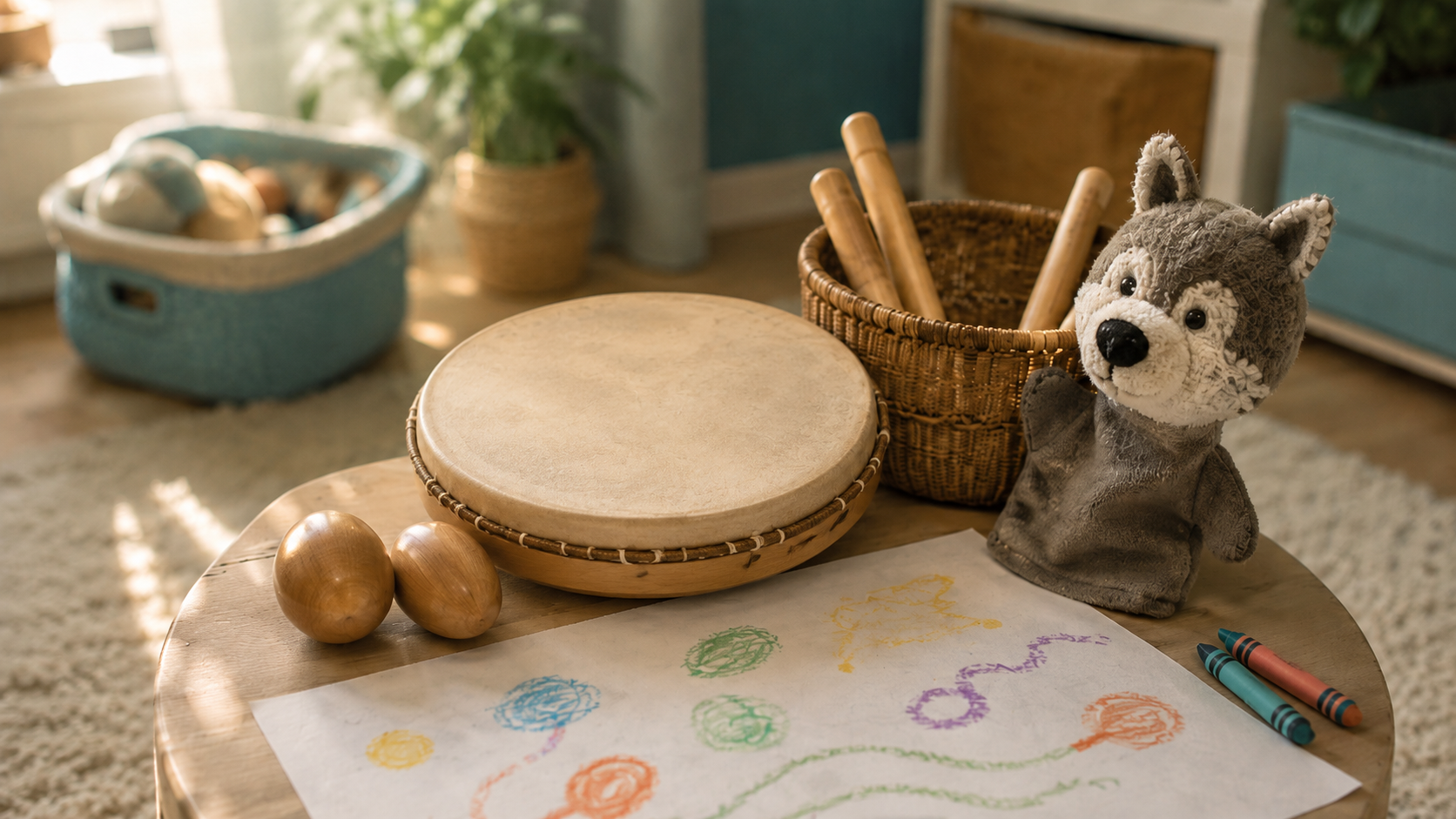
The image most parents hold of a music lesson, scales and sheet music and a teacher counting out loud, has very little to do with what works for a five- or six-year-old. Ask Gillian to walk through a real thirty-minute lesson at this age and the list is full of motion and play: “Drawing symbols, playing our instrument, songwriting, learning notes, using puppets,” she says.
Every one of those activities is teaching something, even though none of them looks like drilling. Drawing symbols is how a child first connects a sound to a mark on a page, the seed of reading music. A puppet gives a shy child a character to sing to and hide behind, which lowers the stakes enough that they actually use their voice. Making up a tiny song turns a child from someone receiving music into someone creating it, which is where ownership begins. Playing the instrument, even for short bursts, builds the physical familiarity that everything later depends on. The variety is not filler to keep a young child entertained. At this age, play is the curriculum.
What this means for a parent choosing lessons is that the right teacher for a young child is one who can teach sideways, through games and characters and invention, rather than head-on through repetition. A lesson that keeps a six-year-old genuinely engaged is doing far more than it appears to, and that is exactly why the format of online music lessons for kids works better than skeptical parents expect: a skilled teacher holds a young child’s attention through the screen with the same toolkit of play.
The most helpful thing a parent can do is also the hardest
When Gillian is asked what she would gently steer parents away from, she does not hesitate, and it is the same thing many loving, involved parents do without realizing: “Parents staying in the lesson or correcting the child while we are in class.”
It is worth sitting with why this is so common, because it comes from the best intentions. A parent stays because they want to help, to remember what to practice, to reassure a nervous child. They correct because they can hear an off note and want to fix it. But for a young child, a parent in the room changes the entire dynamic. The child performs for the parent instead of exploring with the teacher, splits their attention between two authorities, and learns to look to a parent for approval at exactly the moment they should be building their own relationship with the music and the instrument. A gentle correction from a parent, however kind, often lands harder than the same note from a teacher, because it comes from the person whose approval matters most.
The more helpful posture is to hand the music part fully to the teacher and take up a different role entirely: the encouraging audience. Be enthusiastic about the lesson before and after, ask the child to show you what they learned rather than coaching them through it, and let the small stumbles pass without comment. This is genuinely difficult for an attentive parent, which is why it is worth naming out loud. There is a real art to how parents can support a child learning music from the sidelines, and getting it right does more for a young child’s progress than any amount of in-lesson help.
Why starting young is worth it at all
Step back from the mechanics and there is a larger reason Gillian invests so much in the youngest students. After decades of teaching, the thing that still strikes her most is not a technical breakthrough. “I have literally seen people’s lives improve when they study music,” she says, and she means it as an observation, not a slogan.
Part of what she is giving young students is a sense of lineage. One of the moments that still makes the work feel worthwhile, she says, is “getting to introduce my students to our music heroes upon whose shoulders we stand.” A six-year-old does not need a music-history lecture, but they can absolutely fall in love with a sound, a song, a feeling, and that early connection is what a lifelong relationship with music grows from. Gillian has a particular love for teaching the blues “because it has influenced everything we listen to today,” and planting that kind of root early gives a child a foundation that everything else can build on.
None of this requires a child to become a professional, or even to stick with one instrument forever. The research on early music and child development is genuinely encouraging on this front, and the benefits of music lessons for kids reach well beyond the music itself, into focus, confidence, language, and the simple experience of getting better at something hard. Starting young, with the right kind of playful, low-pressure teaching, is how a child gets to keep all of that without ever feeling like it was forced on them.
What to keep in mind as a parent
If you are thinking about starting a young child in music, a few things from Gillian’s experience are worth carrying with you.
The first is that “too young” is rarely the real problem. Children take in music far earlier than most parents expect, so the question is less about age and more about matching the lesson to the child in front of you. A two-year-old and a six-year-old both belong in music; they just belong in very different kinds of lessons.
The second is to judge an early lesson by engagement, not by how serious it looks. A great lesson for a young child is full of games, characters, drawing, and invention, and it is teaching real skills the whole time. If your child is delighted and keeps coming back, the teaching is working, even when it does not resemble the lessons you remember.
The third is to claim the role that actually helps. Step out of the lesson, let the teacher hold the corrections, and become the warm audience your child plays for afterward. It is the harder job, and it is the one that lets a young child build a relationship with music that is genuinely their own.
Frequently Asked Questions
What age can a child start music lessons?
Earlier than most parents think. Gillian finds that children begin absorbing music as early as twelve to eighteen months, though that early stage is about playful exposure rather than structured lessons. By five or six, a child can handle a real lesson, as long as it is built around play, games, and short hands-on activities rather than long stretches of repetition.
What does a music lesson for a five- or six-year-old actually look like?
A mix of activities rather than one long drill: drawing musical symbols, playing the instrument in short bursts, making up little songs, learning notes, and using puppets or characters to keep a young child engaged. Each game teaches a real skill, but at this age play is the way the learning happens.
Should I sit in on my young child’s music lesson?
In most cases it helps more to step out. When a parent stays in the room or corrects the child during the lesson, the child tends to perform for the parent and look to them for approval instead of building their own relationship with the teacher and the music. A more useful role is to be the enthusiastic audience before and after.
How can I support my child’s music learning at home?
Keep it positive and low-pressure. Ask your child to show you what they learned rather than coaching them, let small stumbles pass without correction, and be genuinely encouraging about the lessons. Leaving the teaching to the teacher and the cheerleading to you is what helps a young child most.
Is starting music young actually worth it if my child might not stick with it?
Yes. The early benefits reach well beyond music, into focus, confidence, and language, and they do not depend on a child becoming a professional or staying with one instrument forever. A playful, pressure-free start gives a child a lasting, positive connection to music regardless of where it eventually leads.
About Gillian
Gillian is a singer, multi-instrumentalist, and educator with over thirty years of experience in performance, songwriting, production, and music education. She holds a master’s degree in Contemporary Performance Production from Berklee College of Music in Valencia, Spain, and a bachelor’s degree in music from the University of California, Santa Barbara, with a focus on jazz and classical voice. Her training includes study with master vocal teacher Don Lawrence, and she gained early recognition winning Amateur Night at Harlem’s Apollo Theater. She has taught at Interlochen Arts Academy, the Center for Music and Nature, and Jazz Camp West.
At Tunelark she teaches voice as well as electric bass and upright bass, working with students of all ages and levels in both English and Spanish. Her approach blends vocal health, technique, improvisation, theory, and songwriting in a supportive, personalized environment, and she has a particular gift for meeting the youngest beginners where they are. She came to her own instrument through that same sense of wonder, first drawn in by “hearing solo upright bass with a bow,” and the low frequencies that, as she puts it, “literally stopped me in my tracks.” It is that early spark of discovery that she works to give her students, whatever their age.
Ready to start your child in music?
If you have been wondering whether your child is old enough, or what a lesson would even look like, the encouraging truth is that the right time is probably now and the right lesson is more playful than you imagine. Gillian helps young beginners build a genuine, pressure-free love of music through games, songwriting, and patient hands-on teaching, and she guides parents toward the supportive role that helps most. Gillian is currently accepting new voice and bass students at Tunelark, and she welcomes the youngest beginners and their families, in English or Spanish.
Looking for an online voice teacher? See our full Online Voice Lessons page for everything you need to know about getting started.
Keep reading
About Jennifer Heath
I'm Jennifer Heath, VP at Tunelark and a lifelong singer. I joined the company in 2020 and oversee much of what makes Tunelark work for our students and our teachers. That includes hiring, training, and supporting our instructors, customer and student support, marketing, and the day-to-day operations of the business.
I started voice lessons at age 7, sang with professional choirs that toured internationally through my teens, and performed solo at competitions and community events across Texas before stepping away in my twenties to study other interests, including business management. I haven't performed professionally in years, but I'll happily take the microphone at a karaoke night. Music has been in me every day of my life. Being able to spend the last six years working inside an online music education company, while traveling the world full-time, has been a perfect fit.
I believe deeply that music belongs in every life. For the self-expression, the discipline, the comfort, and the simple joy of it.
The Tunelark blog is where we share what we've learned about online music lessons: how to choose an instrument and a teacher, what to expect from your first lesson, how the major platforms compare, and how to keep music going through the busier seasons of life. Practical, honest writing you can act on.
Who we are
Tunelark provides virtual 1-on-1 music lessons to learners
of all ages.
We remove the barrier of geography and connect learners and teachers — wherever they are. Our growing community of vetted, experienced music educators have expertise in a wide variety of instruments, genres, and skill levels. We are passionate about connecting each student with the perfect instructor.

