
Piano Hand Position for Beginners: The Posture That Prevents Pain
Piano Hand Position for Beginners: The Posture That Prevents Pain
The thing nobody tells beginners about piano hand position: getting it right early saves you years of frustration later. Getting it wrong early creates technical problems that take years to undo, and in some cases create real physical pain. This isn’t meant to discourage anyone. It’s meant to make the case that the first few weeks of paying attention to your hands are some of the most valuable hours you’ll spend at the instrument.
Good piano hand position is not complicated. It’s also not natural. The shape your hands want to make when you put them on a keyboard is usually wrong, and small corrections in the first month carry forward for the rest of your playing life.
Why Hand Position Matters More Than You Think
Bad hand position does three things, and all three of them are bad.
It slows you down. Tense hands can’t move quickly, can’t play evenly, and can’t relax between notes. Almost every speed problem in beginner playing has a hand position problem underneath it.
It limits your dynamic range. To play softly with control, your fingers need to be in a position where small motions produce small sounds. Flat or tense fingers can only play one volume, usually too loud.
It causes pain. Tendinitis, wrist strain, and chronic forearm tension in adult students almost always trace back to early habits with hand position. The injuries pianists pick up are not random. They’re the predictable result of years of small mechanical wrongness.
The good news is none of this is mysterious. A good teacher can correct your hand position in a single lesson, and then it’s up to you to maintain the correction for the next several weeks of practice. After a month or two, the new position becomes the natural one.
The Resting Hand Position
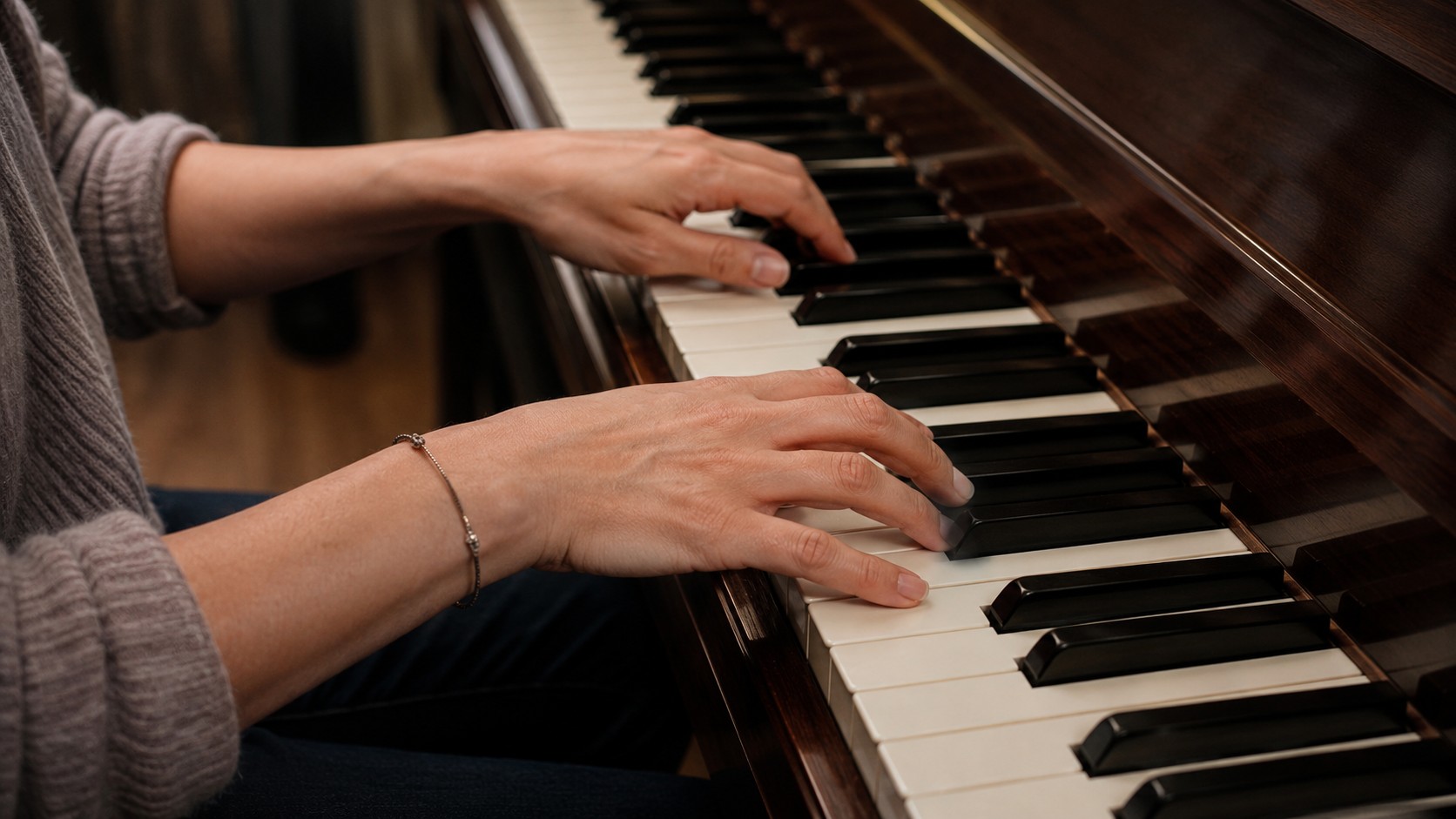
Here’s the position you want, described slowly. Sit at the keyboard. Let your arms hang relaxed at your sides. Notice the shape your hand makes when it’s just hanging, slightly curved fingers, thumb gently positioned forward, palm soft.
Now raise that hand to the keyboard without changing its shape. Place your fingers on the keys with the natural curve intact. The fingertips touch the keys, not the pads of the fingers. The knuckles where your fingers join your hand are gently arched, not collapsed.
The key points:
- Wrists level with or slightly below the back of the hand. Not bent up, not collapsed down.
- Fingers curved, with the joints rounded: imagine you’re loosely holding a small orange.
- Thumb resting on its side, not flat on the keyboard.
- Hand weight supported by your fingertips, not your wrist or forearm.
- Shoulders relaxed, not hunched.
That’s it. The whole frame fits in one paragraph. Maintaining it is the work of months.
Wrist Angle and Why It Matters
The wrist is the single most overlooked part of piano hand position for beginners. Most untrained players let their wrists collapse, the wrist drops below the level of the hand and the forearm angles upward to the keys. This feels comfortable for about fifteen minutes. Then your forearm tightens. Then your hand tires. Then, over weeks of practice, the small constant tension starts to cause real strain.
The correct wrist angle is level. Imagine a straight line running from your elbow through your wrist to your knuckles. The wrist neither bends up nor collapses down. It’s neutral, the same position your wrist is in when you’re typing properly or holding a coffee cup.
A useful self-check: glance down at your hands while you’re playing. If you can see the back of your hand and your wrist clearly, you’re probably collapsed. If the back of your hand and your forearm look like one connected plane, you’re closer to right.
Bench height matters here. If you’re too low at the keyboard, your wrists will naturally angle up. If you’re too high, they’ll collapse down. The right height puts your forearms parallel to the floor when your hands are on the keys. Most adjustable benches and even kitchen chair-with-cushion setups can hit this.
Finger Curve and Independence
The second key element of piano hand position for beginners is the curve of the fingers. Each finger should be naturally bent at every joint, with the fingertip approaching the key from above rather than the pad of the finger lying flat across it.
The classical image is “holding a tennis ball”. Your hand cupped around an imaginary sphere. That’s a useful starting picture, though some teachers prefer “holding an egg” for the gentler grip implied.
Why curve matters: a curved finger has leverage and quick recovery. It can press a key, return to its starting position, and press another key efficiently. A flat finger has neither. It slaps at the key and then has to be re-curled to do anything else.
Finger independence (the ability to move one finger without the others moving with it) is the other half of the equation. Most beginners’ fingers move in pairs at first, especially the fourth and fifth fingers. Slow, deliberate practice of five-finger patterns with attention to each finger lifting independently is the standard fix. The beginner piano tips article covers daily exercises that build this independence.
What Bad Habits Look Like (And How to Catch Them)
A few warning signs to watch for in your own practice.
Flat fingers. Your fingertips are not curved; instead, the pads of your fingers lie across the keys. This kills speed and dynamics immediately. Fix by consciously curling each finger between phrases.
Collapsing first knuckle. The joint where your finger meets your hand caves inward as you press a key, especially with the fourth and fifth fingers. This is a structural problem that needs slow, isolated practice to correct.
Wrist drop. Your wrist hangs below the level of your knuckles. Fix by raising your bench, raising your wrist, or both.
Tight thumb. Your thumb sticks out stiffly or hovers below the keyboard. The thumb should rest lightly on its side, ready to move but not under tension.
Pinky in the air. Your fifth finger lifts away from the keyboard when you’re not using it. Keep it resting gently above the key it would naturally play.
Hunched shoulders. A surprising amount of hand tension starts in the shoulders. If your shoulders are creeping up toward your ears, your forearms are working harder than they should. Drop the shoulders consciously every few minutes.
Catching these habits as a beginner is much easier than fixing them as an intermediate. Many of these patterns are best caught by a teacher watching you play, but you can catch most of them yourself by occasionally recording video of your hands during practice and watching it back. Daily practice with attention to position: see our guide on practicing music at home for structured routines: locks in the good habits and prevents the bad ones from setting.
How to Find a Piano Teacher on Tunelark
Hand position is one of the most teacher-dependent skills in piano. Books and videos can describe it, but a real teacher watching you play catches problems in minutes that you’d take months to notice yourself. If you’re committed to building a strong technical foundation, a teacher is the highest-leverage investment you can make.
1. Browse our teachers and filter by piano.
2. Read bios. Look for teachers who explicitly mention technique, posture, or working with beginners. Those signal someone who’ll watch your hands carefully.
3. Book a trial lesson with one whose profile resonates.
4. After the trial, notice: did the teacher comment on your hand position and posture, or only on the notes you played? Teachers who think about your body from day one save you years of trouble.
Spending your first months at the piano with good hand position is one of the best gifts you can give your future playing self. If you’re curious about the longer journey, our article on how long it takes to learn piano maps out the realistic stages of progress.
Frequently Asked Questions
How long does it take to develop good piano hand position?
The position itself can be learned in a single lesson. Maintaining it consistently in your playing usually takes one to three months of focused practice. After that, it becomes automatic.
Is it normal for my hands to feel tired when I first start?
A little muscle fatigue is normal in the first few weeks as new muscles activate. Sharp pain, persistent ache, or wrist discomfort is not normal and usually signals a hand position or technique problem. Talk to your teacher.
Should I use exercises specifically to build finger strength?
Less than you’d think. Most “finger strength” problems in beginners are actually relaxation problems. Tense fingers that need to learn to release between notes. Slow scales with attention to relaxation help more than dedicated strength exercises.
What’s the most common piano hand position mistake for beginners?
Flat fingers and a collapsed wrist, usually together. Both come from gravity and unfamiliarity with the position. Catching it early and reminding yourself to curl your fingers and lift your wrist gradually retrains the habit.
Will bad hand position really cause injury?
It can, especially in adult students who practice a lot with tight technique. Tendinitis, wrist strain, and chronic forearm tension are real injuries that traced back to years of bad mechanics. Good early habits are genuine injury prevention.
Looking for an online piano teacher? See our full Online Piano Lessons page for everything you need to know about getting started.
Keep reading
About Jennifer Heath
I'm Jennifer Heath, VP at Tunelark and a lifelong singer. I joined the company in 2020 and oversee much of what makes Tunelark work for our students and our teachers. That includes hiring, training, and supporting our instructors, customer and student support, marketing, and the day-to-day operations of the business.
I started voice lessons at age 7, sang with professional choirs that toured internationally through my teens, and performed solo at competitions and community events across Texas before stepping away in my twenties to study other interests, including business management. I haven't performed professionally in years, but I'll happily take the microphone at a karaoke night. Music has been in me every day of my life. Being able to spend the last six years working inside an online music education company, while traveling the world full-time, has been a perfect fit.
I believe deeply that music belongs in every life. For the self-expression, the discipline, the comfort, and the simple joy of it.
The Tunelark blog is where we share what we've learned about online music lessons: how to choose an instrument and a teacher, what to expect from your first lesson, how the major platforms compare, and how to keep music going through the busier seasons of life. Practical, honest writing you can act on.
Who we are
Tunelark provides virtual 1-on-1 music lessons to learners
of all ages.
We remove the barrier of geography and connect learners and teachers — wherever they are. Our growing community of vetted, experienced music educators have expertise in a wide variety of instruments, genres, and skill levels. We are passionate about connecting each student with the perfect instructor.

