
Best Online Saxophone Lessons: How to Find the Right Teacher
Best Online Saxophone Lessons: How to Find the Right Teacher
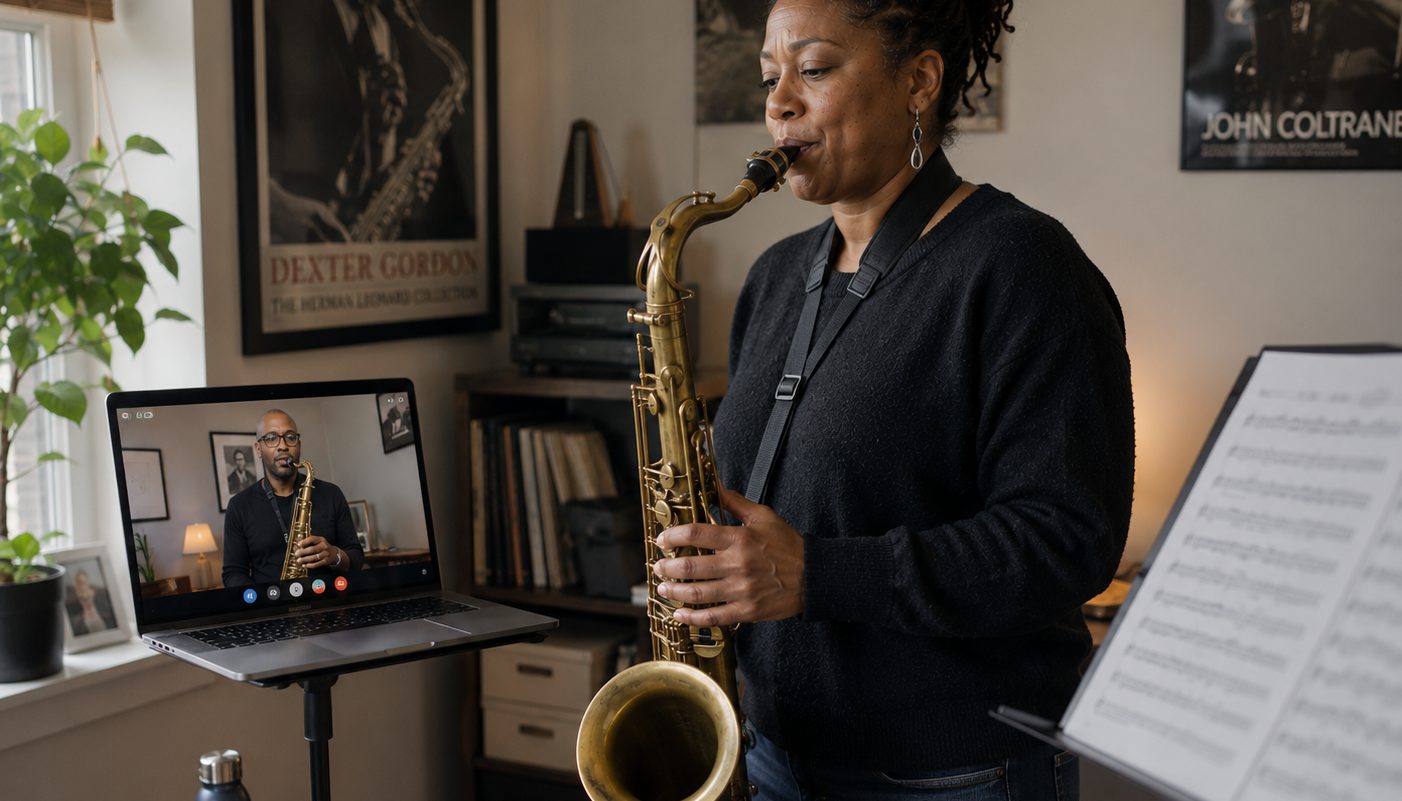
Online saxophone lessons are no longer a compromise. Five years ago, “remote” lessons meant patchy audio, awkward delays, and a teacher trying to diagnose your embouchure through a webcam at the wrong angle. In 2026, that’s no longer the experience, with the right teacher, the right setup, and the right platform, the best online saxophone lessons are genuinely comparable to in-person lessons. For many students, they’re actually better, because you can study with a teacher who isn’t in your zip code.
This guide covers what to look for in an online saxophone teacher, how to set up your own end of the lesson, and how to tell whether a teacher is the right fit before you commit to anything ongoing.
Why Saxophone Translates Well to Online Lessons
Saxophone is, in some ways, an ideal instrument for online instruction. Unlike piano, where a teacher might want to sit at the bench next to you and reposition your hand, most of what a saxophone teacher works on is observable through a screen and audible through a microphone.
A good teacher can hear your tone, your articulation, your time, and your dynamics. They can see your posture, your hand position, your breath support, and the shape of your embouchure. The things that DO matter for in-person instruction (the physical adjustment of your reed, the calibration of your horn) are things you can also do on your own, with your teacher walking you through what to listen for.
The result: online saxophone lessons can be every bit as effective as in-person, provided you’re working with a teacher who knows how to teach in this format.
What Makes a Good Online Saxophone Teacher
Not every great saxophonist is a great teacher, and not every great teacher is a great online teacher. The combination you want has three things:
Teaching experience, not just performing experience. A teacher who has actually taught (not just played professionally) has the language for explaining what to do with your tongue, your air, your fingers. Performance credentials are a nice bonus, but teaching skill is the thing that makes you better.
Comfort with the online format. Look for a teacher whose video and audio quality is good, who’s clearly thought about how they share music or demonstrate on-screen, and who can navigate the technical side without making you do the work.
The right style match. A teacher steeped in classical saxophone tradition is fantastic for an aspiring classical student and a poor fit for a high schooler who wants to play in their jazz band. Read the bio. Ask about repertoire. Make sure the teacher actually plays the kind of saxophone music you want to play.
What to Set Up on Your End
A few practical things make online saxophone lessons dramatically better:
Use a real microphone if you can. Most laptop mics over-compress the saxophone’s dynamic range. Even a basic external USB mic will give your teacher a much clearer sense of your tone.
Position the camera so they can see your hands and your face. Don’t aim it at the ceiling. A teacher needs to see your posture, your embouchure, and your fingerings.
Practice the room, not just the horn. Bad acoustics (a small bathroom-y echo or a totally dead room with thick carpet) both make your sound harder to read. A medium-sized room with some soft furniture and one hard surface is usually ideal.
Use headphones for the lesson. Hearing your teacher clearly is worth more than your teacher hearing the room. Earbuds work fine if that’s what you have.
How to Pick a Teacher on Tunelark
If you’re browsing for an online saxophone teacher, our hand-vetted teacher list is built to make this easier. Every teacher on the platform has been reviewed for credentials, teaching experience, and ability to teach effectively online.
A few things to filter on:
- Style: classical, jazz, contemporary, or a mix. Most students want some flexibility. A teacher who can take you through standards and also help with your school band concerto is the most versatile choice.
- Student age range: some teachers specialize in young beginners, others in advanced high schoolers, others in adult returners. The right age fit matters more than people expect.
- Schedule: evening and weekend availability, time zone fit.
Book a trial lesson with anyone whose profile resonates. Trial lessons are discounted by design, so you can test fit before committing. If the first teacher isn’t right, we make it simple to switch.
A Note on Practice
Lessons are 30 to 60 minutes a week. The other 6 hours a week of practice are where you actually become a better saxophone player. The best online saxophone lessons aren’t the ones with the most expensive teacher. They’re the ones that give you something useful to practice on, between lessons, every single week.
For more on building a sustainable practice habit, our guide on how to practice music at home covers what actually works.
When you’re ready, browse our saxophone teachers and book a trial. The right teacher will pay for themselves many times over in the speed of your progress.
How to Find a Saxophone Teacher on Tunelark
If you’re ready to start, Tunelark’s marketplace is built for exactly this, vetted teachers, trial lessons before commitment, and the freedom to switch if the first match isn’t right.
1. Browse our teachers and filter by saxophone.
2. Read bios. Look for teachers whose approach matches what you actually need, and whose communication style feels like a fit.
3. Book a trial lesson with one whose profile resonates.
After the trial, ask yourself: would you actively look forward to next week’s lesson?
The fit is the whole thing. Take the time to find it.
Frequently Asked Questions
Is saxophone hard to learn?
Saxophone is one of the more approachable wind instruments. Most students produce a decent sound within the first few lessons. Developing fluency, tone, and expression takes more time.
Which saxophone is best for beginners?
Alto saxophone is the most common starting point, manageable size, used across many styles. Tenor and soprano are also options for older or more focused students.
Can saxophone be taught effectively online?
Yes. The teacher can see your embouchure, hand position, and posture on camera, and hear pitch and tone over a good microphone. Online sax lessons are widely used at all levels.
How much should I budget for a beginner saxophone?
A new beginner alto saxophone runs $400–$900. Rentals are typically $30–$50 per month. Avoid very cheap saxophones. They tend to have intonation and key issues that frustrate learners.
Do I need to read music to learn saxophone?
It helps to learn reading early, most saxophone repertoire uses standard notation. Your teacher will introduce note reading gradually alongside playing techniques.
Looking for an online saxophone teacher? See our full Online Saxophone Lessons page for everything you need to know about getting started.
Keep reading
About Jennifer Heath
I'm Jennifer Heath, VP at Tunelark and a lifelong singer. I joined the company in 2020 and oversee much of what makes Tunelark work for our students and our teachers. That includes hiring, training, and supporting our instructors, customer and student support, marketing, and the day-to-day operations of the business.
I started voice lessons at age 7, sang with professional choirs that toured internationally through my teens, and performed solo at competitions and community events across Texas before stepping away in my twenties to study other interests, including business management. I haven't performed professionally in years, but I'll happily take the microphone at a karaoke night. Music has been in me every day of my life. Being able to spend the last six years working inside an online music education company, while traveling the world full-time, has been a perfect fit.
I believe deeply that music belongs in every life. For the self-expression, the discipline, the comfort, and the simple joy of it.
The Tunelark blog is where we share what we've learned about online music lessons: how to choose an instrument and a teacher, what to expect from your first lesson, how the major platforms compare, and how to keep music going through the busier seasons of life. Practical, honest writing you can act on.
Who we are
Tunelark provides virtual 1-on-1 music lessons to learners
of all ages.
We remove the barrier of geography and connect learners and teachers — wherever they are. Our growing community of vetted, experienced music educators have expertise in a wide variety of instruments, genres, and skill levels. We are passionate about connecting each student with the perfect instructor.

