
Performance Anxiety Lives in Your Nervous System: How a Voice Teacher Helps Singers Move Through It
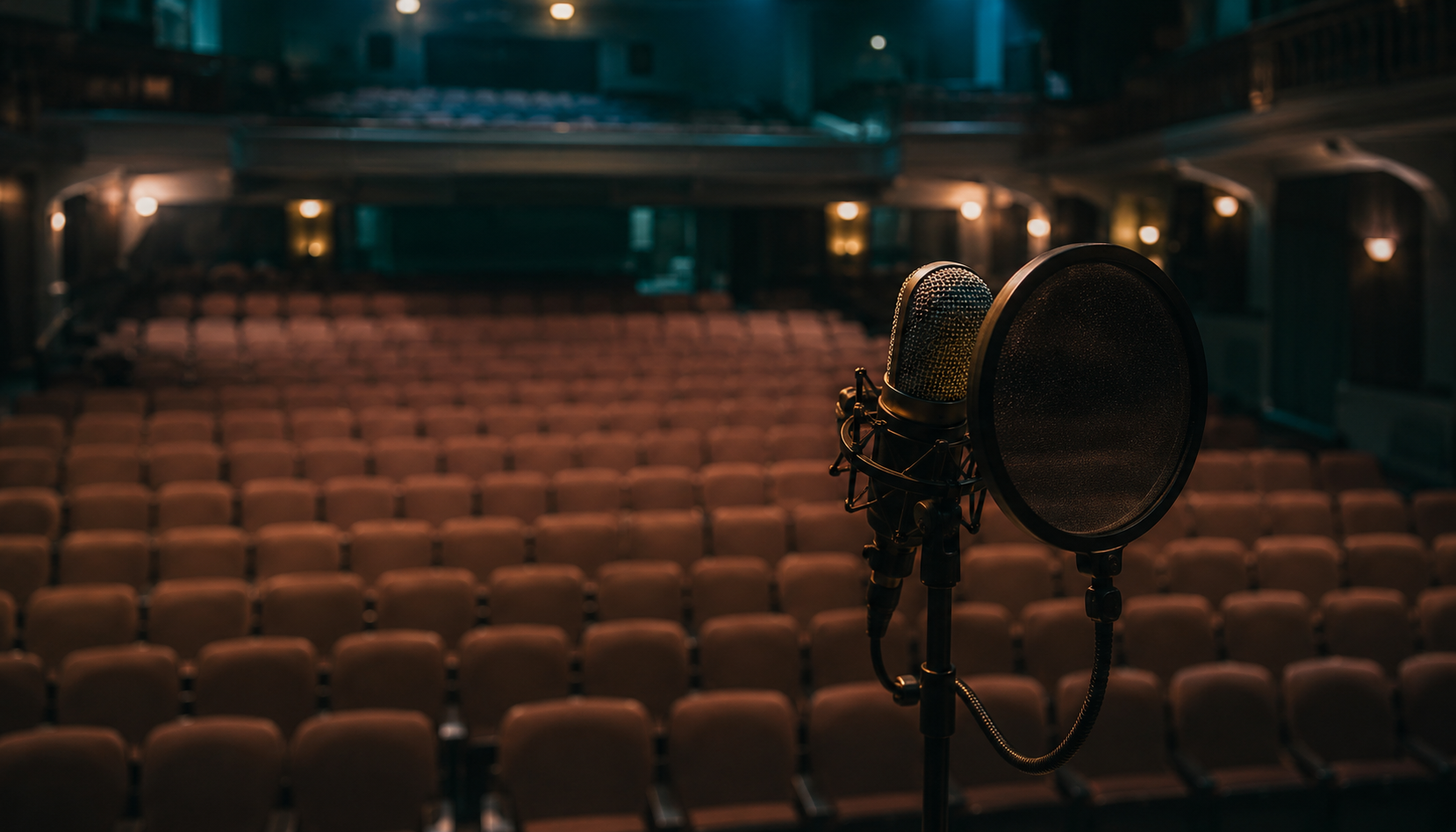
The moment before you sing for another person is its own kind of cliff edge. Your heart speeds up, your breath goes shallow, your hands might shake, and the voice that felt steady in your living room suddenly feels like a stranger. Most singers treat that rush as proof that they are not cut out for this. The more useful reading is almost the opposite. That rush is your body doing precisely what it was built to do.
That reframe is at the center of how Mary Beth S. helps her students through performance nerves. She is a voice instructor at Tunelark with eleven years of teaching and a 27-year performance career of her own, which means she has felt the cliff edge from both sides. And the more she has taught, the more convinced she has become that performance anxiety is not really a confidence problem to be argued away. It is a nervous-system response to be understood and worked with.
Stage fright is your nervous system doing its job
Mary Beth’s framework is refreshingly physiological. “The nervous system is meant to protect you from danger,” she says. “When we get up in front of an audience, the body alerts you to the vulnerable state that is.” Singing in front of people is, in a very real sense, an act of exposure. You are offering something personal and asking to be received, and the body registers that exposure the same way it registers any vulnerable situation, by switching on its alarm.
Seen that way, the racing heart is not a verdict on your talent. It is an alarm bell, and alarm bells are not character flaws. “Some people move through the fear by just talking,” she says. “Some people do not. We all have to learn how to handle that nervous system reaction eloquently.” The promise is not that the fear disappears, because a body that loves you will keep sounding the alarm when it senses you are exposed. The goal is to learn to move through the reaction with some grace, so it stops running the show.
This single shift, from “I am too anxious to sing well” to “my nervous system is protecting me, and I can work with it,” changes the whole task. You are no longer trying to win an argument with yourself about whether you are good enough. You are learning to regulate a physical response, which is a concrete, trainable skill. It is also why nerves are so common even among capable singers and seasoned performers, a point worth keeping in mind whether you are preparing for your first recital or sharing moment or your fiftieth.
The reset that unlocked a held-back voice
The power of this approach showed up vividly in a recent lesson. Mary Beth had been working for about a year and a half with a student who was afraid to belt. They had spent years singing softly, tucking the voice back to blend with the singers around them in a choral setting, and that habit of holding back had followed them into solo singing. The quiet was safe. Letting the full voice out felt like stepping off the cliff.
Around that time, Mary Beth had been thinking hard about the nervous system’s role in a singer’s life, and she decided to bring it directly into the lesson. She had the student place a hand on their chest and repeat a short set of phrases out loud: “I am safe. This is not hard. I have sung this before. Singing loud is a safe thing.” It is part affirmation and part instruction to the body, a way of telling the alarm system that the danger it senses is not real. After two or three rounds, something gave way. The student let loose a full, ringing belt for the first time. “It was beautiful,” Mary Beth says. “All of a sudden her voice was in a new season of discovery.”
Then came the detail that makes the technique believable rather than magical. They decided to record a voice memo of the two of them singing a duet, and on the very first take, the nervous system flared right back up. The microphone reintroduced the exposure, and the body responded on cue. Mary Beth did not treat that as a failure. She repeated the phrases with the student and reassured them that flaring on the first take is completely normal. Then the student delivered three clean takes in a row, holding their pitches the whole way through, as the two of them sang “Shallow” together. The fear did not vanish. It came back, got handled, and stopped being in charge. For Mary Beth, the lesson left a permanent mark on how she teaches: “I can never leave out the nervous system ever again when talking about performance anxiety. Never.”
Building calm into the weeks before a performance
Nervous-system regulation is most powerful when it is rehearsed long before the spotlight, not improvised under it. So Mary Beth folds the calming work into ordinary practice, starting with the warmup. “I typically give people a warmup they can do that will simultaneously warm them up and calm them down,” she says. The warmup does double duty: it readies the voice and it settles the body, so a singer is training both halves of performance at once instead of treating nerves as a separate emergency to deal with later.
She also makes the calming tools part of the weekly homework. “We discuss options for anxiety calming they can put in their warmup routine for the week,” she says, so by the time a show arrives, regulating the nervous system is a familiar habit rather than a technique the singer is trying for the first time under pressure. A warmup that already includes a breath or an affirmation the singer has used a dozen times at home becomes an anchor on the day it counts. If you want a sense of what those daily building blocks look like, a consistent set of vocal warm-up exercises is the natural place to attach them.
As a performance gets close, the structure of the lessons shifts. “Two lessons before the show, I typically try to run the songs, give one thing to think about, and then run it again,” she says. The pattern is deliberate: a full run to simulate the real thing, one focused adjustment so the singer leaves with something concrete to hold onto, and a second run to put that adjustment into the body. Then the final lesson changes character entirely. “The lesson before the show is all about performing the songs,” she says, without stopping to fix issues along the way. That last rehearsal is not for polishing. It is for practicing the experience of performing start to finish, nerves and all, so the real thing feels like one more rep rather than a leap into the unknown.
What she says right before they perform
For all the structure, the moment that often matters most is the one just before a singer steps out. Asked for the most useful thing she has said to a student right before they performed, Mary Beth does not reach for a pep talk or a reminder about technique. She goes back to the body. The most useful thing, she says, is “walking them through the calming techniques for nervous system regulation.”
It is a telling answer. The instinct many of us have in that final minute is to coach harder, to remind the singer about breath support or that tricky entrance. Mary Beth’s instinct is to do the opposite, to help the singer settle their alarm system so the skills they already own are available to them. A regulated nervous system does not add talent. It removes the interference that was hiding the talent already there. The work she has done with them over the weeks, the affirmations, the calming warmups, the full run-throughs, all of it converges on that single steadying moment at the edge of the stage.
That is what makes her approach to performance anxiety so usable for ordinary singers, not just polished performers. It does not ask you to feel fearless, because fearless is not how a healthy body responds to exposure. It asks you to understand what your body is doing, to practice calming it until that practice is second nature, and to trust that the nerves can show up, get handled, and let you sing anyway. If singing in front of people is the thing keeping you on the sidelines, that is a workable problem, and the first step is often just starting lessons with someone who treats nerves as part of the craft rather than an obstacle to apologize for.
About Mary Beth
Mary Beth teaches voice at Tunelark, across every age and a wide range of genres, including jazz, pop, musical theater, country, gospel, classical, R and B, and worship. She is an eight-time award-winning vocalist with a bachelor of arts in music from Friends University in Wichita, Kansas, where she focused on jazz and joined the school’s well-known jazz ensemble as a freshman. That was the start of a 27-year performance career that has included opening for Pentatonix, and her debut album is titled Discovering Home.
She has taught voice for eleven years, and from the beginning her mission has been to help singers who are dealing with vocal pain and low confidence find their freedom. That focus is why the nervous system features so heavily in her teaching: confidence, for many singers, is less about self-belief and more about a body that has learned it is safe to be heard. In her studio, the priority is a space where each student can relax, fall back in love with music, and grow as an artist, which is exactly the ground performance nerves need in order to loosen their grip.
Ready to sing for people without the fear running the show?
If performance nerves have been keeping your voice smaller than it wants to be, you do not have to white-knuckle your way through them. Mary Beth teaches singers to understand the nervous system, rehearse calming it as part of normal practice, and walk to the edge of a performance with tools they have used many times before. Mary Beth is currently accepting new voice students at Tunelark. Bring the nerves. They are welcome here, and they are workable.
Frequently Asked Questions
Is performance anxiety a sign I am not cut out for singing?
No. According to Mary Beth, the rush of nerves before you sing is your nervous system protecting you from a moment it reads as vulnerable, which is a normal, healthy response rather than a verdict on your ability. Even experienced performers feel it. The skill to learn is not how to feel fearless, but how to move through the reaction so it stops getting in the way.
Can performance nerves actually be reduced, or do you just live with them?
They can absolutely be worked with. Mary Beth treats nerves as a nervous-system response you can learn to regulate, using tools like calming warmups, affirmations, and grounding techniques practiced over time. The aim is not to erase the response but to handle it gracefully, so it can show up, settle, and let you sing.
What is a quick technique for calming nerves before singing?
One Mary Beth uses is placing a hand on your chest and repeating calming phrases that tell your body it is safe, such as “I am safe” and “I have sung this before.” Pairing that with a warmup that both prepares the voice and slows the breath helps settle the nervous system. The key is to practice these tools regularly, so they are familiar by the time you need them under pressure.
How should lessons change in the weeks before a performance?
Mary Beth builds toward the date in stages. Two lessons before, she runs the songs fully, offers one focused thing to work on, then runs them again. The final lesson is devoted to performing the songs straight through without stopping to fix things, so the singer rehearses the actual experience of performing. Calming techniques are woven into the warmups throughout, not added at the last minute.
What is the most helpful thing to do right before stepping out to perform?
Rather than last-minute coaching on technique, Mary Beth walks her students through calming techniques for nervous-system regulation. The idea is that the skills are already in place, so the most valuable move in that final moment is to settle the body’s alarm response, which clears the way for the singer to perform what they have already prepared.
Looking for an online voice teacher? See our full Online Voice Lessons page for everything you need to know about getting started.
Keep reading
About Jennifer Heath
I'm Jennifer Heath, VP at Tunelark and a lifelong singer. I joined the company in 2020 and oversee much of what makes Tunelark work for our students and our teachers. That includes hiring, training, and supporting our instructors, customer and student support, marketing, and the day-to-day operations of the business.
I started voice lessons at age 7, sang with professional choirs that toured internationally through my teens, and performed solo at competitions and community events across Texas before stepping away in my twenties to study other interests, including business management. I haven't performed professionally in years, but I'll happily take the microphone at a karaoke night. Music has been in me every day of my life. Being able to spend the last six years working inside an online music education company, while traveling the world full-time, has been a perfect fit.
I believe deeply that music belongs in every life. For the self-expression, the discipline, the comfort, and the simple joy of it.
The Tunelark blog is where we share what we've learned about online music lessons: how to choose an instrument and a teacher, what to expect from your first lesson, how the major platforms compare, and how to keep music going through the busier seasons of life. Practical, honest writing you can act on.
Who we are
Tunelark provides virtual 1-on-1 music lessons to learners
of all ages.
We remove the barrier of geography and connect learners and teachers — wherever they are. Our growing community of vetted, experienced music educators have expertise in a wide variety of instruments, genres, and skill levels. We are passionate about connecting each student with the perfect instructor.

