
How to Build Engagement with Online Music Students
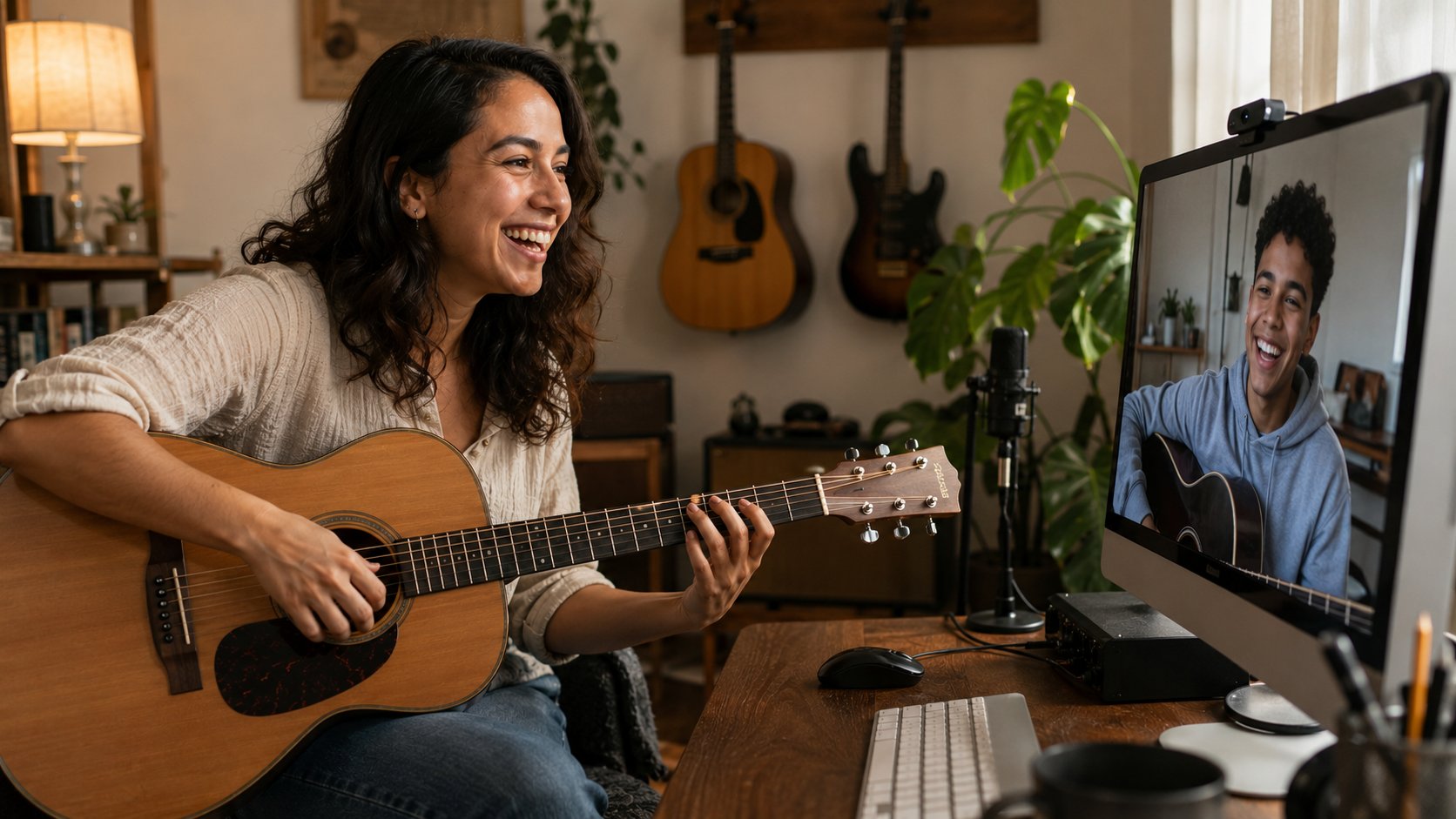
The fear behind most engagement worries is simple: without sharing a room, the teacher loses the thousand small cues (a glance, leaning in, the energy of a held breath) that tell you whether a student is with you. Those cues do thin out on video. But the answer is not to mime in-person teaching through a webcam. It is to build engagement out of the things video does better than a room: instant reference sharing, recording, asynchronous review, and a documented thread that runs from one lesson into the next. Done deliberately, that thread holds students for years.
This article covers the concrete mechanics: what to do inside the lesson, what to do between lessons, how to adjust by age, how to read disengagement before a student quits, and how recording quietly compounds all of it.
What Actually Moves the Needle
Engagement is not a mood you create with enthusiasm. It is the predictable result of three conditions, and online tools let you engineer all three more tightly than a room does.
The student sees progress they did not see before. Vague encouragement (“you’re getting better”) does almost nothing. Specific, observed progress does everything. Record a 20-second clip of a passage in week one, record the same passage in week six, and play them back to back. The student hears the gap close in real time. This is the single most reliable engagement tool online teaching gives you, and it is most of why seeing concrete milestones keeps students motivated better than praise ever will.
The material connects to something they actually want. Online lessons make this trivial: a student can send you a link to a song an hour before the lesson, and you can pull it up on screen together. Build at least one piece of student-chosen repertoire into every cycle, even if it is above their level and you only extract a four-bar riff from it. The piece they begged to learn is the piece they will practice without being told.
The relationship feels continuous, not transactional. A student who feels like a paying customer in a slot will churn the moment life gets busy. A student who feels known will reschedule rather than cancel. Continuity is engineered, not charismatic, and the rest of this article is largely about how to engineer it.
Engagement Mechanics Inside the Video Lesson
The screen flattens energy, so you have to build structure that the room would otherwise supply for free.
Open with thirty seconds of the student playing, not you talking. Have them play anything they choose, even badly, before you give a single instruction. This flips the default online dynamic (teacher presents, student receives passively) into shared music-making from second one. It also gives you an instant diagnostic of where their hands and ears are that day.
Name the camera angle as a teaching tool, not a limitation. Ask the student to reposition their device deliberately: phone propped to show both hands for a technique passage, then back to a face-on view for the conversational stretches. Giving the student control of their own framing (“point the camera at your right hand for this part”) makes them an active participant in being seen rather than a fixed image on your screen.
Demonstrate, then have them play along to your recording. Play a phrase, hit record, and let them practice against the playback while you watch and coach. Audio latency makes real-time duet playing unreliable online, so stop fighting it. Use record-and-review instead, which is a stronger learning tool anyway because the student can hear the model as many times as they need.
Reserve the last five minutes for free play. Protect a closing block where the student improvises, jams, or plays whatever they want with no correction. Adult students routinely name this as their favorite part of the lesson, and it is frequently the reason they book the next one. Cutting it to “get more done” is a false economy.
End by stating the one thing for this week out loud and writing it down where they can see it. Not five assignments. One clear, observable target (“by next week, the B section hands-together at 60 bpm”). Ambiguous homework is the leading cause of guilty, avoidant practice and the slow drift that follows.
Between-Lesson Touchpoints: Where Engagement Actually Lives
The lesson is one hour. The week is the other 167. Engagement is won or lost in the gap, and online teaching gives you cheap, high-impact ways to stay present in it without becoming on-call.
Send a voice note instead of a text. “I was thinking about your bridge passage. Try landing on the downbeat with your thumb instead of your index finger.” Thirty seconds to record, and it lands as care in a way typed words do not, because the student hears your attention. Voice notes are the highest-return-per-minute tool in online teaching.
Answer hard questions with a 60-second screen-recorded video. When a student emails “I can’t get the roll clean,” do not type three paragraphs. Record yourself playing it slow, then at tempo, with one sentence of explanation, and send the clip. It is faster for you and clearer for them.
Keep a shared progress document the student can actually open. A simple running log (date, what we worked on, the one target, links to any clips) turns a series of disconnected sessions into a visible arc. Reference it out loud: “Three weeks ago you couldn’t do this at all.” Students who keep their own version benefit even more, which is why it is worth coaching them on taking notes during their own lessons.
Be reachable, not always-on. Quick replies build trust; 24/7 availability burns you out and trains dependence. Set an explicit rhythm (“I answer messages within a day, weekdays”) and keep it. Predictability reads as more reliable than instant.
A note on practice itself: between-lesson messages should support practice, not nag about it. When a child is not practicing, the cause is usually a vague assignment, a piece that is too hard, or a setup problem, not laziness, and the fixes for helping a child actually practice are structural rather than motivational.
Adjusting by Age: Toddlers, Children, Teens, Adults
The same engagement principles apply across ages, but the tactics that deliver them differ sharply.
Toddlers and very young children (roughly 3 to 5). Sessions should be short (15 to 20 minutes) and built almost entirely from movement, imitation, and call-and-response. The screen is a hard ceiling on attention here, so lean on the parent as a second pair of hands in the room: the parent physically guides the child to the keys or holds the small instrument while you lead. Sing instructions rather than speaking them. Expect to abandon your plan and follow the child’s energy.
Children (roughly 6 to 11). Break a 30-minute lesson into four or five short activities with visible transitions, not one continuous block. Use concrete contingent rewards: “Play this clean three times in a row and we spend the last five minutes on the song you picked.” Digital or paper sticker charts work because children respond to visible accumulation. Build in a physical reset (“stand up and clap this rhythm”) the moment focus flags, because a fidgeting child is almost always a child whose body has been still too long.
Teens. The fastest way to lose a teenager is to talk to them like a child or to fake enthusiasm they can smell. Treat their taste as legitimate, build lessons around music they actually listen to, and let them have real input into direction. Recording works especially well here because teens are used to evaluating themselves on screen. Be careful to separate the teen who is genuinely done from the one who is just frustrated, because a child who wants to quit and a child who hates practicing need opposite responses.
Adults. Adults engage as collaborators, so ask them what is working and adjust openly. Give them the reason behind every instruction; the 30 seconds of “here is why” that feels skippable is what keeps an adult bought in. Anchor lessons to a concrete real-life goal (a wedding song, surprising a partner, managing performance nerves) and name the difficulty out loud, because adult beginners carry real embarrassment, and saying “most adults take months to feel natural with this” lowers the load measurably. Respect their time ruthlessly: starting late or running long reads as disrespect and erodes loyalty faster than any technical shortcoming.
Running Parental Involvement So It Helps Instead of Hurts
For younger students the parent is part of the lesson whether you plan for it or not, so plan for it. Give the parent an explicit, narrow job, because an uncoached parent defaults to either disappearing or correcting, and both undermine you.
What helps: silent presence, handling the technical setup, gently steering the child back to frame, and (for the youngest) physically guiding hands when you ask. What hurts: correcting the child mid-lesson, answering questions aimed at the child, sighing at mistakes, and turning practice at home into a battleground. Say this directly at the first lesson: “The most useful thing you can do is be nearby and quiet, and let me be the one who corrects. Your job at home is to make practice happen, not to police how it sounds.” Parents almost always comply when given a clear role, and the difference in the child’s engagement is immediate. For the longer arc, point parents toward how to support a child’s music learning without hovering, which is the harder skill and the one that keeps kids enrolled.
Catching Disengagement Before It Becomes a Cancellation
Online, you cannot rely on reading the room, so you have to watch for named, observable signals. A drifting student usually shows several of these before they quit:
- They stop sending you anything between lessons. The questions, song links, and “I figured out the thing” messages dry up.
- They are vague about practice and offer no detail when you ask what they worked on.
- They have stayed on the same piece for weeks with no visible appetite to move on.
- Cancellations and reschedules tick up above their baseline.
- Their affect on camera flattens: shorter answers, no laughter, eyes drifting off-screen, camera angle getting lazier.
When you see two or three of these together, do not wait and do not paper over it with extra cheerfulness. Open it directly and without blame. A script that works: “I’ve noticed the last few lessons have felt a little different, and I want to check in. Is something getting in the way, or is the music itself not landing right now? I would rather adjust what we do than have you push through something that isn’t working.” This does two things at once. It signals you are paying attention, and it separates a logistics problem (busy season, schedule conflict) from a content problem (bored, stuck, intimidated), which need completely different fixes. Often the cause is mundane and fixable. Sometimes the answer is to change repertoire, lower the difficulty, or aim at a near-term performance. A scheduled, low-stakes recital or performance moment to prepare for frequently re-engages a stalled student faster than anything you can do inside a regular lesson.
How Recording and Async Review Compound Everything
Recording is the throughline that makes the rest of this work, and it is worth treating as core infrastructure rather than a nice extra.
It makes progress undeniable. Side-by-side clips from weeks apart turn “I think I’m improving” into proof, which is the most durable fuel for long-term motivation. It extends the lesson into the week, because the student can replay your slow demo as many times as they need instead of relying on memory. It sharpens self-assessment: students who watch themselves play start hearing their own timing and tone problems without you pointing them out, which accelerates everything. And it deepens the relationship, because a teacher who keeps and revisits a student’s recordings is visibly invested in the arc, not just the hour.
Set expectations once, clearly: recordings are for personal review, not public posting, and for minors get explicit parental consent before recording anything. Used this way, recording quietly turns a 60-minute weekly transaction into a continuous, documented relationship, which is precisely the thing that keeps online students for years.
How Tunelark Vets Its Teachers, and Why It Matters for You
Most lesson marketplaces let almost anyone create a profile. Tunelark doesn’t, and the difference is structural rather than cosmetic: a smaller, genuinely vetted roster means each accepted teacher sees more of the incoming student demand, not less.
Our vetting is run by working musicians and music teachers with decades of teaching and performing experience, not a general recruiter or an HR screener. The people evaluating a pianist’s playing and teaching actually understand piano pedagogy. Specifically, the process includes:
- A sample performance. We ask to hear you play or sing. Musicianship is the foundation everything else is built on.
- A teaching sample. Performing and teaching are different skills, so we evaluate how you actually explain, diagnose, and correct, not just how well you play.
- Education and credential verification, plus background checks. We confirm your training and run background checks. That matters especially because many students are children.
- Testimonials from former students. We want evidence of real results with real learners, not just a résumé.
That depth is why “vetted” means something on Tunelark. It protects students, and it protects the teachers who clear the bar, because the roster stays selective enough that strong teachers actually get found instead of disappearing into a directory of hundreds.
Where Tunelark Fits for Teachers
Tunelark is a marketplace, not a matchmaker. We don’t assign students to teachers. We build the strongest accurate version of your profile, with photos, an introduction and performance video, testimonials, and your bio, and present it in our Find-a-Teacher search, where students browse and choose for themselves. You set your own rates and teach your own way; we don’t touch your curriculum.
We’re also honest about who the students are: most find us by searching for lessons online or through a referral, and many are beginners. What Tunelark provides is a steady stream of motivated inbound students you didn’t have to pay to acquire, with billing, scheduling, support, and payment processing handled for you, a 1099 at tax time, and a few data-backed policies, a 24-hour cancellation policy, limits on late teacher cancellations, and minimum availability, that exist because across more than 100,000 lessons they are what protects student retention and, with it, your income.
How to Become a Music Teacher on Tunelark
1. Apply to teach and submit a short profile.
2. Share a brief introduction along with a sample of your playing and your teaching.
3. Our team of experienced musicians and teachers reviews applications and follows up with teachers who meet the bar. We keep the roster selective on purpose.
4. Once you’re approved, you set your own rates, availability, and lesson approach, and we handle scheduling, billing, payments, and student discovery around you.
Tunelark works best for experienced teachers who care about long-term student relationships and want a platform that respects both their time and their craft.
Frequently Asked Questions
Are online students actually less engaged than in-person students?
Not inherently. The medium thins out some in-room cues, but it adds tools (instant reference sharing, recording, async review, a documented progress thread) that in-person teaching lacks. Engagement tracks the design of the relationship far more than the format. Many teachers report their longest-tenured students are online ones they have never met in person.
What is the single highest-impact thing I can do between lessons?
Send a short voice note. It takes thirty seconds, it carries warmth that text cannot, and it keeps you present in the student’s week without making you feel on-call. Pair it with a one-line, observable practice target stated at the end of each lesson, and you have covered most of what drives between-lesson engagement.
How do I keep a young child focused on a screen?
Treat focus as a setup problem, not a character problem. Use short lessons broken into four or five activities, build in physical movement resets the moment attention flags, use visible contingent rewards, and coach the parent to be a silent, helpful presence rather than a corrector. Most online focus issues with children dissolve once the structure and the parent’s role are fixed.
How do I tell a student is drifting before they quit?
Watch for clustered signals: between-lesson messages drying up, vague answers about practice, weeks stuck on the same piece, rising cancellations, and flatter affect on camera. When two or three show up together, open it directly with something like, “Lessons have felt a little different lately, is something getting in the way, or is the music not landing right now?” That conversation usually surfaces a fixable cause.
Should students record their lessons?
Yes, for almost everyone. Reviewing recordings accelerates progress, sharpens self-assessment, and makes growth visible in a way that sustains motivation. Set expectations that recordings are for personal review only, and for any student under 18, get explicit parental consent before recording.
Keep reading
About Jennifer Heath
I'm Jennifer Heath, VP at Tunelark and a lifelong singer. I joined the company in 2020 and oversee much of what makes Tunelark work for our students and our teachers. That includes hiring, training, and supporting our instructors, customer and student support, marketing, and the day-to-day operations of the business.
I started voice lessons at age 7, sang with professional choirs that toured internationally through my teens, and performed solo at competitions and community events across Texas before stepping away in my twenties to study other interests, including business management. I haven't performed professionally in years, but I'll happily take the microphone at a karaoke night. Music has been in me every day of my life. Being able to spend the last six years working inside an online music education company, while traveling the world full-time, has been a perfect fit.
I believe deeply that music belongs in every life. For the self-expression, the discipline, the comfort, and the simple joy of it.
The Tunelark blog is where we share what we've learned about online music lessons: how to choose an instrument and a teacher, what to expect from your first lesson, how the major platforms compare, and how to keep music going through the busier seasons of life. Practical, honest writing you can act on.
Who we are
Tunelark provides virtual 1-on-1 music lessons to learners
of all ages.
We remove the barrier of geography and connect learners and teachers — wherever they are. Our growing community of vetted, experienced music educators have expertise in a wide variety of instruments, genres, and skill levels. We are passionate about connecting each student with the perfect instructor.

